Monday, January 12, 2015

Ballpark Bandwagon Breakdown

Between January and September of 2014 Richmond witnessed the coalescence of a significant resistance to the notion of building a baseball stadium in Shockoe Bottom. In May the volume of the opposition chorus apparently surprised Mayor Dwight Jones (pictured left). Now it seems unlikely Jones’ so-called “revitalization” plan, as originally advertised, is ever going fall into place.

However unpopular with the voters the mayor’s plans for Shockoe Bottom and North Boulevard have become, shifts in the thinking of some on City Council may animate makeovers in 2015. What effect the rearranging of councilmanic chairs will have on the ballpark issue isn't known, yet. As we wait for that drama unfold, it's worthwhile to organize the 2014 record of the brouhaha for the sake of facilitating a clear perspective.

What came to stifle the mayor’s stadium-building scheme last year began gathering over the winter. Although no single entity was coordinating it, by early spring the escalating criticism of the Jones plan was pouring in from several directions.

However, now it seems there was one standout event that proved to be the tipping point. It appeared out of the blue on Apr. 28. On that Monday morning a group of students from Richmond public schools appeared at City Hall with a purpose. The majority of them were from Open High.

Whether one called it a "flash mob," or a "walkout," the protest march had obviously been prompted by a couple of telling Style Weekly articles ("Caving In" and "Filling Holes") published earlier the same month. The stories revealed dreadful conditions in some local public schools; the students acted on their own volition. They carried signs with messages for all to see. Some messages decried dilapidated school buildings. Others protested the Shockoe Stadium plan.

The next surprise came later that same fateful day. Instead of dispatching a brief note to congratulate the kids for their civic-minded moxie, and to say he was too busy to meet with them, Hizzoner decided to smooth the students’ ruffled feathers with his practiced mayoral patter. Well, in baseball parlance, Jones "booted" his chance to make a play. His painfully awkward response to the students' questions about the city's skewed spending priorities was worse than inadequate.

Naturally, the local media were all over the story of a flummoxed mayor. The kids looked good on TV.

*

Pre-turning point:

When Mayor Jones rolled out his large-dollar plan to “revitalize” the city on Nov. 11, 2013, he presented the building of a baseball stadium in the Bottom as an essential component. He spoke of how it would create jobs, enlarge the city's tax base and get a slavery-related museum built, too.

No doubt, 2014 began with the perceivable momentum on the mayor's side. Jones’ Chief Administrative Officer and top salesman, Byron Marshall, appeared more than up to the task of ramrodding the taxpayer-backed project through Richmond’s nine-member City Council.

As the baseball-in-the-Bottom bandwagon chugged through the first month of the 11th year of baseball stadium debate in Richmond, dissent to the mayor’s plan couldn’t be heard over establishment media-amplified boosterism. Venture Richmond’s ubiquitous LovingRVA public relations campaign was pumping high-test fuel into the bandwagon’s tank.

That, while no person or organization was speaking for the scattered opposition. Some wanted to protect Shockoe Bottom from an outrageously inappropriate development. Some saw another build-it-and-they-will-come boondoggle in the making. Others stood against what they believed to be an impractical plan, a plan that turned a blind eye on what baseball fans seemed to prefer.

Leading up to 2014, The Virginia Defender, published by Ana Edwards and Phil Wilayto, had been focused on the issue for years. Owing to that effort and those of other activists, in February the resistance to baseball-in-the-Bottom continued gathering. STYLE Weekly stayed on the stadium beat with a series of news stories and several Back Page OpEds.

The role of social media was snowballing. Facebook pages dedicated to opposing Shockoe Stadium included: Referendum? Bring It On!Save the DiamondSay No to a Stadium in Shockoe BottomShockoe ResistanceA Stadium RVA Can Love!. Outdoor billboard signs went up. Yard signs were posted. Activist Farid Alan Schintzius headed up the signage approach.

In March and April the Citizens Referendum Group held meetings at the City Library to discuss crafting a strategy to put a baseball stadium referendum on the ballot. Although that ad hoc group’s ambitious petition-signing campaign didn’t collect enough signatures to force such a referendum, the connections the undertaking created could come into play again. Many names and addresses of registered voters were collected. (An archive of published notices and articles on this issue is here.)

Other petitions were circulated. Boycott strategies came also into play. Political gadfly Paul Goldman weighed in with an avalanche of opinion pieces for WTVR.com. Although his message meandered over the year, Goldman was relentlessly hard-hitting with his many objections to pursuing the mayor's Shockoe Stadium concept.

In the wake of the notoriety of the Oscar-winning movie, “12 Years a Slave,” on March 25 the Hollywood Reporter weighed in: “Where the jail that held Solomon Northup once stood, a state-of-the-art baseball stadium may soon rise. That’s if the mayor of Richmond, Va., has his way.”

*

Post-turning point:

On Apr. 29, Preservation Virginia announced its Most Endangered Sites List for 2014, which included Shockoe Bottom. At this point three members of City Council were on record as being opposed to the mayor’s plan. They were: Parker Agelasto, Chris Hilbert and Reva Trammell.

The first of May brought news of an alternative stadium proposal, one for the Boulevard from a new developer. A week later Doug Wilder stuck his thumb in Jones’ eye by announcing his intention to revive his much-traveled slavery museum concept and locate it a couple of blocks from where the mayor wanted to put a similar museum.

On May 23, City Council members Charles Samuels and Jon Baliles put out a joint press release announcing their decision to let the sputtering Shockoe Stadium bandwagon pass them by. Joining with their three colleagues already prepared to vote against the mayor‘s plan, a new five-member majority was thus created. The bandwagon screeched to a sudden halt.

Four days later, Mayor Jones’ office announced his development plan for the Boulevard and the Bottom was being temporarily withdrawn from consideration. It was then anticipated the plan would be re-worked and introduced at a Council meeting before the summer was over.

Nonetheless, inside City Hall during June the stadium issue languished. In July Trammell suggested a referendum might be the best way to go. Her fellow Council members didn’t see it her way.

On August 3 a group of merry Richmonders paraded around The Diamond to mock the notion of demolishing it, only to build a replacement in the Bottom. As the accordion music swelled -- playing "Take Me Out to the Ballgame" -- some paraders may have wondered, once again, what the point of the LovingRVA campaign had been in the first place.

Was it to persuade the public? Or perhaps certain members of City Council?

In September, without much in the way of an explanation, Byron Marshall resigned. In the absence of a freshened up presentation from the mayor's office Council went on with other business.

*

If rumors are to be taken seriously, it now seems one member of last year's five-member-majority may flip this year. Time will tell. Still, what the mayor and any potential flip-flopping politicians should take to heart is this plain truth:

The opposition that swelled up in 2014 won’t be difficult to reanimate. It hasn’t gone anywhere, even if some politicians and rainmakers twist all the arms they can reach. After years of this issue flapping in the breeze, most voters have their minds made up. More salesmanship isn't going to change those minds much.

Moreover, last year’s coalescence of factions created something bigger than the sum of its parts. It’s something that isn't likely to ever stand aside for that old ballpark bandwagon. Nor is it likely to forget flip-floppery. For 2015, one thing is a safe bet: Dwight Jones wants no more face-to-face meetings with sign-carrying students at City Hall.

-- 30 --

-- Photo from Richmond.com

Wednesday, January 7, 2015

Je suis Rebus Charlie

But, of course!
 
It's not a matter of whether those cartoons in France were good art, or bad. Not whether they were clever commentary, or plain silly. Not whether they were overly offensive, or too provocative. It's about whether we've gotten so scared of bullies that we're afraid to laugh, or not afraid. 

Satire has always been dangerous. Rebus ain't scared.  

-- My art. Take it, or leave it.

Saturday, December 6, 2014

Giving Peace a Chance

The first pass at telling this tale appeared in SLANT 
in 1987. The version below is an update.


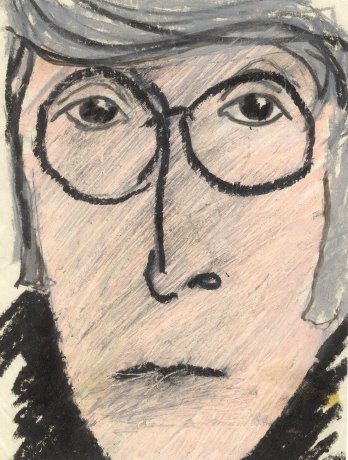
John Lennon
Illustration by Mike Lormand (1984)

On the occasion of the anniversary of his death, on Dec. 8, 1980, I can’t help but wonder what the founder of the Beatles — John Lennon, a master of word-play and sarcasm — would have to say about today's music, art and politics.

It would be anybody's guess. After all, in his nearly 20 years as a public figure Lennon’s knack for changing before our eyes was dazzling. There's no reason to think such a restless soul wouldn't have kept on changing.

In November, 2008, on the occasion of what was the 40th anniversary of the release of the Beatles’ White Album, the Vatican newspaper praised the groundbreaking British band for its body of work and forgave Lennon for his flippant 1966 quip about sudden success, “[We’re] more popular than Jesus.”

Even the bloody Vatican has changed but it seems peace, itself, is still waiting off-stage for its chance.

In February of 1964 the Beatles made their initial appearances on the Ed Sullivan Show. At the time most people probably didn’t connect the events, but those two appearances were less than three months after the assassination of President John F. Kennedy and the numbness that followed. Surely, the somber mood of the nation had something to do with why the harmony of those crisp Beatles songs cut through the airwaves with such verve.

Clearly, there's been no explosion in the American pop music scene since 1964 with anything like the impact of Liverpool’s Fab Four. Nothing since has equaled Beatlemania.

Then, in 1980, the murder of moody John Lennon had an impact on the public most of us wouldn't have predicted. It was as if a world leader had been gunned down on the street in Manhattan. Lennon’s obvious contributions as a songwriter and musician were huge. But it was his startling sincerity, together with his quick sense of humor that set him apart from some of his pop star counterparts who dabbled with social causes like they were hairdos. 

With the Vietnam War still underway in the early ‘70s, President Richard Nixon looked at Lennon and saw the raw power to galvanize a generation’s anti-establishment sentiments. Fearful of that potential, the Nixon administration did everything it could to hound Lennon out of the country. The details of that nasty little campaign are just as bewildering as some of the better known abuses that flowed from the Dirty Tricks Department in the White House during those scandal-ridden days.

With so many years of perspective on Lennon’s death, I have to say that even if that particular nut-case (a man I choose not to name because I refuse to add in any way to his celebrity) hadn’t pulled the trigger, it could easily have been another one; there were other bullets out there with John Lennon’s name on them.

Like the comets of each generation tend to do, sometimes Lennon burned too bright for his own good. And, speaking of assassinations, at this time I’m also reminded of an item that ran in the Nashville Banner on Feb. 24, 1987. The article began with this:
Two Nashville musicians remained free on $500 bond today after they went on a magazine-shredding tear …to protest People magazine’s current cover story.
The two musicians were Gregg Wetzel, and Mike McAdam. As members of the Good Humor Band they were fixtures in Richmond’s rock ‘n’ roll scene in the early ‘80s. By the time the story mentioned above was published, the pair had established themselves as respected sidemen in Nashville — Wetzel on piano and McAdam on guitar.

In a nutshell, Gregg and Mike became incensed at seeing the magazine with a cover story about John Lennon’s murderer. They felt spotlighting the killer in that way might encourage another deranged wannabe to take gun in hand to go after whoever. So they fortified themselves with an adequate dose of what-it-takes — legend has it they were drinking out of an Elvis decanter — and set out on a mission to destroy the cover of every copy of the offensive publication they could find.

As the reader may know, this sort of endeavor is frequently best undertaken in the wee hours. In the course of their fifth stop, at a Nashville convenience store, the avenging angels were stopped by the cops and charged with “malicious mischief.”

Shortly afterwards, in a interview about the incident, McAdam said at the time, “If another guy like [name withheld again] sees that, he might think he can get on the cover of People magazine by killing a politician or artist.”

Bravo!

Chief among the reasons John Lennon was selected for the kill by his stalking murderer was he had a rare ability to move people. In that sense, Lennon was slain for the same reason as political figures such as Martin Luther King and Robert F. Kennedy. Two thousand years ago Jesus H. Christ was taken out of the game for much the same reason. All of them challenged people to change, to take a chance on a life based on something better than might making right. 

Although Nixon miscalculated Lennon’s intentions, the soon-to-be-disgraced president was probably right about the former Beatle’s potential to focus the anti-establishment sentiments in the air. What Nixon didn’t grasp was that Lennon — in spite of his mischievous streak — was really more interested in promoting peace than fomenting revolution.

“The cops looked at me and McAdam,” said Wetzel, to flesh out the 25-year-old tale, “decided we weren’t exactly flight risks and entrusted our transport to the pokey with an attractive female officer, all by her lonesome. On the way to the hoosegow, Mickey hit on the cop. True story.”

Thirty-four years after Lennon's shocking death we're left to imagine, as best we can, what the 74-year-old working man's wiseass would have to say now. 

Peace.

-- 30 --

Thursday, November 6, 2014

A Perfect Panic

America has come a long way from this
classic approach to fear management.

Virginia is said to be a blend of blue for Democratic and red for Republican. Paint it purple. The closeness of the result of Virginia's senatorial race on Tuesday underlined that characterization. Such symbolic graphics tell an easy story.

Yet, for 2014’s election results, so far the analysts haven't started talking about the color I saw that was all over the map of the country on Tuesday. Yellow. It stands for fear. But rather than being neatly gathered inside the respective states, it’s splattered across the map, Jackson Pollock-style.

ISIS beheadings and Ebola landing in Texas were the principal fear factors this season. When the books are written about this year’s elections, I suspect we'll find the collective fear of terror stunts and a virus helped Republicans far more than it helped Democrats. Fear was probably a crucial factor in some contests that were close coming down to the wire. 

Of course, this is hardly the first time for fear to be a significant factor in an election year. What was a modern variation on an old tactic in 2014 was the over-the-top manner in which terrorism in the Middle East and disease in Western Africa were pumped up by political flacks and the media, just before mid-term elections. It created a two-headed monster, the stuff of nightmares. 

Not only did fear make cowards of many voters, it twisted some candidates into odd shapes. In Virginia’s neighbor to the west, Kentucky, Alison Lundergan Grimes lost to Sen. Mitch McConnell. Lost badly. When her handlers told her to play a silly game of refusing to say if she voted for Pres. Barack Obama in 2012, apparently she was too afraid to fire them. It made her look not-ready-for-prime-time. And, Grimes wasn't the only Democrat to go through awkward contortions to artificially distance herself from Obama.

The last time the Democrats ran away from a sitting Democratic president it was 14 years ago. That decision didn't work so well for Al Gore, either. It's a losing strategy. It makes the candidate disavowing the leader of their own party look like a hypocrite who is willing to say anything to get elected. Turnout suffers. 

Here in Virginia, Sen. Mark Warner also took some bad advice. His fear of losing to Ed Gillespie made him come across as a different man during the campaign, especially in its late stages. Hey, I like Warner and I voted for him, but I had to try to forget about Warner’s woefully poor performance in a debate I watched, not to mention his grim attack ads. Now I hope I'll never see such a fearful Mark Warner again.

However, to be fair, Warner and Grimes were both probably looking at data that told them the October momentum was favoring their opponents. Apparently it was for Democrats in several states. Given the momentum Gillespie had in the last couple of weeks of the campaign, if it had lasted another week he may well have defeated Warner.

Remember Y2K fear? Remember crop dusters spewing anthrax fear? Remember mosquito-born West Nile virus fear? Remember the weapons of mass destruction fear that launched a war in Iraq? Remember Bird Flu fear? Remember the fear of conducting trials for terrorists in American courtrooms? Then there was the fear the federal government would default on its debts ... and so forth.

While stoking a convenient panic is hardly a new strategy in political campaigning, the timing of the ISIS beheadings and Ebola coming to our shores created a perfect panic. Talk about your October Surprises!

Remember when the Bush administration instituted a color code for how much fear was appropriate for any given day? Now I fear the professional propagandists in politics have learned so much about how to use fear to destroy opponents and win elections that from here on we’re going to be living in a yellow alert world, trembling at the mere thought of orange.

Still, at the bottom line, we all know the color that actually drives politics in 2014 is the same as it ever was -- it's green, baby! green for money.

Friday, October 24, 2014

Chasing Dignity

Note: A version of this piece was published by STYLE Weekly in 2006

“…Now once more the belt is tight and we summon the proper expression of horror as we look back at our wasted youth. Sometimes, though, there is a ghostly rumble among the drums, an asthmatic whisper in the trombones that swings me back into the early twenties when we drank wood alcohol and every day in every way grew better and better, and there was a first abortive shortening of the skirts, and girls all looked alike in sweater dresses, and people you didn’t want to know said ‘Yes, we have no bananas,’ and it seemed only a question of a few years before the older people would step aside and let the world be run by those who saw things as they were — and it all seems rosy and romantic to us who were young then, because we will never feel quite so intensely about our surroundings any more.”
    – from “Echoes of the Jazz Age” (1931)
by F. Scott Fitzgerald

In the summer of 1978, with “The Rocky Horror Picture Show” playing to the delight of a midnight show packed house, a fight broke out in the middle of Grace Street. Insults, rocks and bottles flew back and forth between the two factions of four or five each. It appeared to be VCU frat boys vs. an Oregon Hill crew.

The battle was unfolding a perilous 30 to 40 yards from the Cinemascopic all-glass front of the Biograph Theatre, a Fan District cinema I then managed. The box office had just closed and the cashier had started her count-up. At the same time a group of my Biograph Swordfish softball teammates was in the lobby, playing a pinball machine. It’s likely we were drinking beer out of soft drink cups.

As the theater’s manager, I felt obliged to protect the Biograph by driving the danger away. So I opened one of the lobby’s two glass exit doors and yelled that the cops were already on the way. Then I probably asked a cashier to call the cops.

That announcement was good enough for the frat boys, who scampered off. Their opposites simply switched over to bombing me. As they advanced, rocks bounced closer. A tumbling bottle shattered on the sidewalk. I retreated and closed the door. Then a piece of brick smashed through the door’s bottom panel. It rudely collided with my right shin.

Well, that was that! When we lit out after them, our impromptu posse of pinball players and film buffs consisted of six, maybe seven guys. The hooligans scattered, but my focus was solely on the one who’d plunked me. Hemmed in by three of us in a parking lot, he faked one way, then cut to the other. When his traction gave way slightly in the gravel paving, he stumbled to regain his balance. A second later I tackled him by the legs.

With some help from my friends, we marched the captured 19-year-old along the sidewalk toward the theater. The feeling of the adrenaline coursing through my limbs is still a vivid memory. It sure felt good to have caught the guy who attacked the Biograph.

During the trek east on Grace Street -- which, in 1978, was still a one-way street, heading west -- the culprit said something that provoked one of the guys in the group to suddenly turn and punch him in the face. That, while the punchee’s arms were being held. It happened in front of Grace Place.  

One of the policemen assembled on the sidewalk around the entrance to the theater saw it. He sarcastically complimented the puncher for his inspired “technique.” Shortly afterward, the brick-throwing street-fighting man was put into the paddy wagon and taken to jail.

A few minutes later I told the vigilante puncher that I thought he had overreached in hitting the kid, especially while he was helpless. I probably said it was totally unnecessary. Surprised by my reaction, the puncher, who was a softball teammate, laughed and shrugged. He disagreed, saying that his summary punishment would likely be the only price the little thug would ever pay for his crime. He pointed at my bleeding shin.

Which prompted me to say something like, “Hey, if we resort to their tactics, we’re no better than the damn fascist bullies we’ve claimed to deplore.” I suppose by saying “we’ve,” I meant something like -- us peacenik hippies.

As we went inside the theater to resume our pinball game another teammate voiced his agreement with the puncher. From the discussion that followed, it seemed the group was evenly split on the propriety of the punch.

*

It wasn’t long after that night I found myself poring over an essay by F. Scott Fitzgerald, “Echoes of the Jazz Age.” The excerpt above is the evocative piece’s last paragraph. During that rereading, it occurred to me the shattering glass door had been the sound of the hippie era ending. It was over. That street fight was a glance into the future for that neighborhood. Just like hippies didn’t prove to be the new beatniks, punks weren’t going to be the new hippies. 

As the '70s fizzled down my baby boomer generation was about to discover that our sweetest day in the sun -- with its righteous causes and rock ’n’ roll anthems -- had been another dollop of time. It had been a period with its fashionable looks and sounds, its way of walking, like eras. In some ways, Gatsby’s Roaring ’20s, redux.

A month or so later I agreed to the court’s proposal to drop the assault charge, provided the brick-thrower was convicted of a misdemeanor for breaking the glass and paid for the damage. A payment schedule was set up. As we spoke several times after that, I came to see the “hooligan” wasn’t really such a bad guy. Payment was made on time. Eventually, he asked me for the name of the man who’d punched him.

While withholding the name, I agreed with him that the blow had been a cheap shot. He seemed to take some satisfaction from that bit of validation.

 *

About a year later, on a late summer afternoon, a thief snatched a handful of dollar bills from a Biograph cashier -- Augusta “Gussie” Armeniox -- then bolted out the front door. The cashier’s wide-eyed look of fright triggered an alarm in your narrator’s sense of duty/propriety. Gussie’s face was quite expressive.

As this happened half of my lifetime ago, I was still young enough to think chasing criminals down the street was normal. Quaint as it may sound now, at the moment it seemed then that some collective sense of dignity was at stake. So I chased the thief.

He ran between buildings and then back out to the street. Then he disappeared around a corner. In short, it took less than 10 minutes to discover the thief’s hiding place. I had flagged down a cop during the chase, so I pointed out where the robber was and the cops hauled him off.

However, during the search I received some unexpected help in cornering the thief. As I had run west on Grace Street behind the 20-year-old grab-and-run artist, another young man — a total stranger — had jumped out of his pickup truck to join in the chase.

Later, when the dust settled, I thanked the volunteer and asked him why he’d stopped. He answered that because a buddy of his had once pointed me out, he knew I was the Biograph’s manager. His friend?

It was the same Oregon Hill street-fighter I’d tackled a year before. My assistant thief-chaser then told me his friend had assured him that I’d dealt fairly with him. Consequently, he owed a favor was to me. Before he left, my collaborator said that in his neighborhood the guys stick together. Thus, he’d supported me in my time of need, to help pay off his friend’s debt.

We shook hands.

*

Over the years what connects those two chase scenes has become increasingly more satisfying to me. No doubt that’s because so many times over the years, in dealing with bad luck and other ordinary tests of character, I’ve done nothing to write home about — even the wrong thing.

At least in this story, maybe, I got it right. Still, I know times have changed. My guess is that today more people would agree with the guy who punched the kid.

So, in a way this story is nostalgic. It looks back through the mists of “ghostly rumbles” and “asthmatic whispers,” to a dollop of time when cheap shots were still frowned upon. It was when returning favors was part of what held things together.

-- 30 --

Sunday, July 13, 2014

Please, Reva, Watch Your Step

In a Richmond Times-Dispatch article penned by Graham Moomaw and Michael Martz -- “Jones Dismisses Boulevard Stadium as 'Second-Best'” -- it says Mayor Dwight C. Jones has turned his back on building a new baseball stadium on the Boulevard. Well, it seems to me the mayor has turned around on this issue more than once.

Via email, Mayor Jones' office told Moomaw and Martz the mayor has "ruled out" the idea of a new stadium on the Boulevard. The email added that Jones will “enthusiastically reintroduce” the revised Shockoe Stadium plan when he senses, “the time is right.”

My respect for good timing notwithstanding, after reading more warmed over folderol along those lines, a few sentences near the bottom of the piece caught my attention. In part, it read:
Councilwoman Reva M. Trammell, of the 8th District, plans to introduce a resolution calling for an advisory referendum to allow voters to weigh in on the stadium issue in November.
Bravo, Reva Trammell!

Yes, John Q. Public definitely wants to have some say-so on this issue. After hundreds of conversations about this matter with all sorts of locals, I have no doubt of that. However, the wording of the referendum's proposal is supremely important.

The writing task can get sidetracked by hidden agendas. It can get twisted by trying too hard to avoid stepping on any toes, whatsoever. All of which can lead to tortured language that isn't clear and precise enough to gather the support it deserves. Word the thing wrong and it will get picked to death.

Over the last year, I’ve seen how that wording process can get butchered. So, I hope Ms Trammel’s mind is open to input from some folks who’ve already given a lot of thought to what an "advisory referendum" ought to set out to accomplish.

Please note: However well intended, last summer Charles Samuels’ advisory referendum proposal wasn’t well written. It failed by a 6-3 vote, probably for several reasons, but part of it was the wording was confusing. The Citizens Referendum Group’s two proposals (Proposition A and Proposition B) are also unclear in ways that have seemed to work against them. At this point, I won’t speculate about why the wording of both of those efforts failed to be clear enough to articulate specific goals, or to inspire widespread confidence.  

Given what I've learned about how NOT to do it, I hope Trammell will state at Monday night's City Council meeting exactly what her aim is with a referendum. Then I hope she and her colleagues who agree with her will put a small team of writers together, people who are in accord with that stated aim, to craft the new proposal's language.

After all is said and done, in my view, a well-written ballot proposal would finally allow voters in all nine districts a chance to say whether, or not, Shockoe Bottom should be declared a special historic area that is a “no-stadium zone.” This approach would not say where to build, or whether to renovate. It would simply rule out the Bottom for sports stadiums and arenas. It would protect an old neighborhood many have come to understand now matters to the nation's history

After Richmond's voters overwhelmingly reject Shockoe Bottom as a place to build a baseball stadium -- yes, I'm quite sure they will -- City Council should promptly call for proposals to build a new stadium and/or renovate the old one. Yes, I think the Save the Diamond concept should be studied. The process of gathering proposals should be wide open. Moreover, there’s no reason to rush the selection process by setting artificial dates for the Flying Squirrels to open a season in their new or renovated home.

After public hearings, City Council should be the entity to select the best plan. After all of Mayor Jones’ starts and stops, promises and changes, grins and fits, Turn! Turn! Turn! it will be time for him to forget about launching any more PR campaigns and just stand aside to await Council's decision. 

Richmond is still learning how to make its 10-year-old "strong mayor" system work smoothly. Now it’s fair to say it's been demonstrated that Richmonders don’t really want their mayors acting as shills for cabals of developers, contractors and hidden players, to build large publicly-financed projects. For the next two years the mayor should probably focus mostly on trying to be a good executive.

Bottom line: Go for it, Reva!

-- Photo from Reva Trammell's Facebook page.

Saturday, June 28, 2014

What Was the Point of LovingRVA?


http://www.lovingrva.com/ 
In 2014 the propaganda supporting Mayor Dwight Jones’ plan to build Shockoe Stadium has had three dimensions. First, there’s been his own ability to make statements and force-feed information into the media. On top of that there’s been a small squad of online commenters who’ve posted supportive talking-point blather under every article on the topic they could find. And, finally, there’s been the rather unusual LovingRVA campaign.

Propaganda aside, the contentiousness over whether or not to build a baseball stadium in Shockoe Bottom can’t be explained by partisan politics, as usual. Mayor Dwight Jones, who is a Democrat, is the chief proponent of building Shockoe Stadium, or whatever it would be called.

Although Jones won reelection handily in 2012, at that time it wasn’t generally understood that a year later Jones would change his position, to come out in favor of baseball in the Bottom. So he’s not in a position to say he was elected to move professional baseball from the Boulevard to the Bottom.

Eight of the nine sitting representatives on City Council were endorsed by the Richmond City Democratic Committee in 2012. Five of those eight are now on record as being opposed to the Jones plan.

According to a survey published by the Richmond Times-Dispatch in October of 2013, two-out-of-three Richmonders opposed baseball in the Bottom. If that number has changed, my guess is more are now against baseball in the Bottom. Guessing is all we can do to say how the issue breaks down for Democrats and Republicans. But it appears the Democrats on City Council are more in accord with their constituents than the mayor is.

For a new stadium to be successful in the Bottom it would seem the mayor should have baseball fans on his side. Unfortunately, that doesn’t seem to be true.

By and large, history lovers are against it, too. The National Trust for Historic Preservation just named Shockoe Bottom to its list of the 11 Most Endangered Historic Places in the country. So, other than people who have property involved, or those who will profit directly from the buildings that are planned, who's for the mayor's plan?

Perhaps a few people who liked the blast of propaganda that was the LovingRVA public relations/ad campaign? For a month, or so, it helped to create the illusion that the coming of Shockoe Stadium was inevitable. But do we know as much about what was behind it as we should?

Yes, I’ve read that the Alliance Group designed it and Venture Richmond was involved in developing it. However, since Venture Richmond gets some good portion of its funding from the City of Richmond, now I hope City Council will investigate how the LovingRVA public relations campaign came about. I’ve read that the campaign cost $32,000, but do we really know that for sure? And, if Venture Richmond paid any part of the bill, doesn't that suggest John Q. Public's money was involved?

Moreover, I’m especially curious to hear the designers of the campaign to tell us exactly who the primary target for message of LovingRVA was. Was its point to sell something to the general public? Members of City Council? And, what concept was the copy and the art crafted to sell to its target?

Given how slowly details of the proposal how been revealed, perhaps six months ago it was meant, in part, to provide cover for the lack of firmed up details?

So we can all breathe easier City Hall needs to make a thorough accounting of the LovingRVA campaign for the record. It’s time for some sunlight. Although it now seems the rather unconvincing campaign was mostly a flop, some questions about its purpose and propriety are lingering like bad air.

-- Words and art by F.T. Rea

Monday, May 26, 2014

The Fan District's Goddess of Democracy

http://photos1.blogger.com/blogger/6291/212/1600/GoddessDemoc1b.jpg

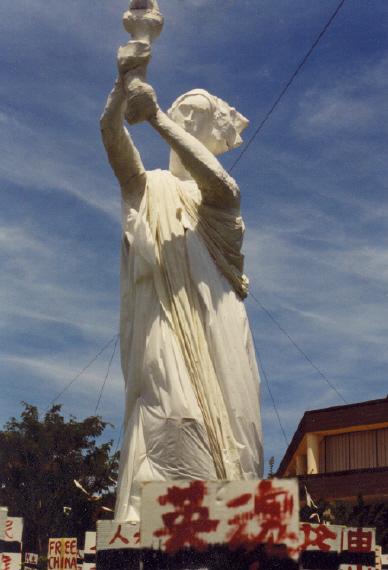
Twenty-five years ago, this week, the Goddess of Democracy was erected in Tiananmen Square. Made of chicken wire, papier mâché and plaster, it was built by art students. It symbolized their call for democratic reforms in China. The protest in Tiananmen Square had begun in mid-April; tension was mounting.

Subsequently, on June 4, 1989, following orders, the People’s Liberation Army put an end to the demonstration. Mayhem ensued. Although reports varied widely, hundreds, if not thousands, were killed. The Goddess of Democracy was destroyed during the routing of the protesters that had remained to the end, in defiance. As the drama played out on television, via satellite, the events shocked the world.

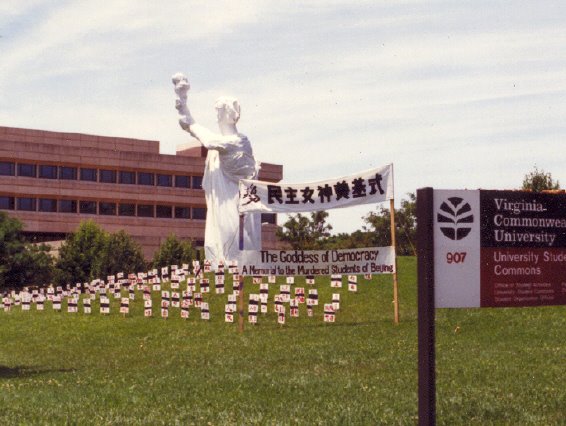
As their art student counterparts in China had been murdered in the shadow of their 33-foot-tall sculpture, in Richmond a group of VCU-affiliated artists heard the call of inspiration to stand with those who had fallen. They decided to build a replica of the lost Goddess.

The impromptu team of the willing and able worked around the clock for the next couple of days to give form to their tribute to the courage of those who had perished for the sake of freedom of expression. While the project was not sponsored by the school, wisely, VCU did nothing to discourage the gesture.

The Fan District's Goddess of Democracy (pictured above and below) stood the same height and was made of the same basic materials as the one in China had been. Facing Main Street, it stood as a memorial for about a month in front of the student center. CNN had a report on it, as did many other news agencies. Its image was on front pages of newspapers all over the world.

http://photos1.blogger.com/blogger/6291/212/1600/GoddessDemoc2a.jpg

The little placards on sticks that surrounded the sculpture were added a few days after the Goddess was completed. While it was easily one of the coolest things ever to happen in the Fan District, art-wise, but to my knowledge, nobody made a penny out of it. It was constructed and maintained entirely by volunteers.

It was also a wonderful illustration of how traditional right and left, liberal and conservative, characterizations of all things political don’t always do justice to the truth of a situation. Was the stubborn and heavy-handed Chinese government standing to the right, or to the left, of the upstart students calling for reform? When communists are the conservatives clinging to the old way, how does that play out on a spectrum of left-to-right thinking?

In 1990 I published a piece in SLANT to commemorate the first anniversary of the building of VCU's Goddess. In the article I inserted the text of a handbill that I had found posted at the site of the memorial the year before:
"On May 13, 1989, Beijing University students began an occupation of Tiananmen Square to call for democratic reforms and an end to official corruption. The ensuing peaceful and often festive protest drew world attention and gained support from the citizens and workers of Beijing. On Sunday, June 4, at 3:30 [a.m.] Chinese time, troops of the 27th Division of the People’s Liberation Army entered the square with orders to disperse the students. At approximately 6 a.m. these same troops attacked the protestors with automatic weapons, tanks, and bayonets. According to government estimates only 300 students were killed, but local medical estimates put the death toll between 500 and 1,000.

"The brutal suppression of unarmed students by a powerful totalitarian government has moved the world’s conscience. Many of the Tiananmen victims were art students who aspired to same basic freedoms which we enjoy daily. As American artists we cannot overlook, and we must never forget, the suffering and sacrifice of our brothers and sisters in Beijing. Their peaceful struggle was a cry for human rights everywhere, and their symbol, the Goddess of Democracy, was the highest artistic tribute they could pay to humanity’s noblest ideal -- freedom."

Also in that week's issue of SLANT were stories of a lighter nature. There was a piece about the then-bubbling NEA/Mapplethorpe controversy that had Sen. Jesse Helms flapping in the breeze. There was coverage of the Fan District Softball League -- the Bamboo Cafe led the Mars Division; Chetti’s led the Jupiter Division. Among that issue's advertisers were: 353-ROCK, Blab Television, the Brass Knocker, Brown Distributing, Bug Haus, Chetti’s, the Fan Market, Paradise Cafe, Price’s Market, Soble’s and South of the James.

The Goddess of Democracy on VCU’s campus in 1989 was the most successful piece of guerilla art I have seen in my travels.

-- My photos.

Friday, May 9, 2014

Leroy 'Satchel' Paige at Parker Field

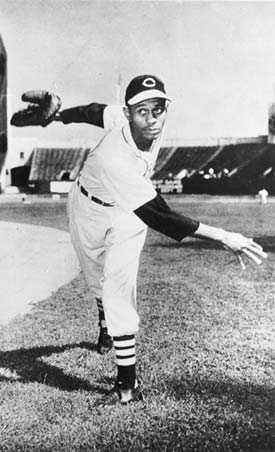
Satchel Paige as a Cleveland Indian
With all the talk about where to play professional baseball in Richmond, I can’t help but think of Parker Field, which was a temple of baseball in my youth. So I can't swear some tiny part of my opposition to building a new stadium in Shockoe Bottom doesn't stem from my warm memories of people and events at Parker Field, which was located where the Diamond is now.

Parker Field opened in 1954 to serve as home for a new International League club — the Richmond Virginians. The Baltimore Orioles (formerly the St. Louis Browns) joined the American League that year, leaving an opening in the IL for the Richmond entry. Most fans called them the "V's."

As the V’s were one of the New York Yankees’ Triple A farm clubs, in those days the Bronx Bombers paid Richmond an annual visit in April. Just before Major League Baseball’s opening day, Mickey Mantle, Yogi Berra, Whitey Ford and the other great Yankees of that era would play an exhibition game in Richmond against V’s. It was always a standing-room-only affair.

Other than the pinstripe-clad hometown V’s my favorite club of the IL then was the pre-revolution Havana Sugar Kings. They played with an intensity, bordering on reckless abandon, it made them a lot of fun to watch, especially for the kids.

One of my all-time favorite pitchers I saw at Parker Field was Leroy “Satchel” Paige (1906-82). Yes, the legendary Paige, with his windmill windup, high kick and remarkably smooth release still working for him, plied his craft on the mound here in Richmond to the delight and other reactions of local baseball fans.

In 1971, Paige (pictured above, circa 1949) was the first of the Negro Leagues’ great stars to be admitted to Major League Baseball’s Hall of Fame, based mostly on his contributions before he helped break the Major League color line in 1948, as a 42-year-old rookie. The statistics from his pre-Big League days are mind-boggling. It's been said he won some 2,000 games and threw maybe as many as 45 no-hitters.

Furthermore, long before the impish boxer/poet Muhammad Ali, there was the equally playful Satchel Paige, with his widely published Six Guidelines to Success:  
  • Avoid fried meats that angry up the blood.
  • If your stomach disputes you, lie down and pacify it with cool thoughts. 
  • Keep the juices flowing by jangling gently as you walk. 
  • Go very lightly on the vices, such as carrying-on in society - the society ramble ain’t restful. 
  • Avoid running at all times. 
  • Don’t look back, something may be gaining on you.

Long after his days as the best pitcher in the Negro Leagues, following his precedent-setting stint in the American League, Paige was on the roster of the Miami Marlins (1956-58). Like the V’s the Marlins played in the International League. When I saw him Paige was in his 50s. Not in the starting rotation, anymore, he mostly worked out of the bullpen.

In the 1950s live professional baseball in Richmond was mostly a white guys’ scene. Which meant the boos would start as soon as the crowd noticed Paige’s 6-3, 180-pound frame warming up in a game's late innings. When he’d be called in to pitch the noise level would soar. Not all the grown men booed, but many did. That, while their children and grandchildren were split between booing, cheering, or embarrassed and not knowing what to do.

Naturally, some of the kids liked seeing the grownups getting unraveled, so Paige was all the more cool to them. Sadly, for some white men in Richmond, then caught up by the thinking that buoyed Massive Resistance, any prominent black person was seen as someone to be against. So, they probably would have booed Duke Ellington or A. Philip Randolph, too.

The showman Paige would take forever to walk to the mound from the bullpen. His warm-up pitches would each be big productions, with various slow-motion full windups. Then the thrown ball would whistle toward home plate with a startling velocity, making some of the kids cheer and laugh ... to mix with the boos.

 
Paige as a Miami Marlin in the 1950s

Paige, from Mobile, Alabama, must have understood what was going on better than most who were watching him perform. He was a seasoned veteran who knew perfectly well there wasn’t much he could do to change the boos; they were coming from folks trapped in the past. Alas, a past for Richmond that only a hundred years before Paige was on the mound at Parker Field included a busy slave market in Shockoe Bottom.

So, Paige played to the cheers, as experience over time had taught him to do. Of course, as a 10-year-old I lacked the overview that what I was seeing was an aspect of the difficult changes the South was going through, to do with race.

My guess is few spectators at the time grasped that the reaction to Paige, largely being split on generational lines, was a signal of how America’s baseball fans were going to change -- one day Jim Crow attitudes would have no place at baseball temples.
Now, with the benefit of decades of reflection, I understand that Satchel Paige was a visionary. He was seeing the future by following his own advice -- Don’t look back.

– Images from satchelpage.com