Saturday, August 18, 2012

Time-Warping in Tampa: Romney’s Step to the Right

 …And then a step to the right
With your hands on your hips
You bring your knees in tight
But it's the pelvic thrust that really drives you insane,
Let's do the Time Warp again!

-- From “The Time Warp” by Richard O’Brien
 
With the Cold War moving from front pages into history books, it was during Bill Clinton’s stint in the White House that ideology began to go out of style in the national dialogue. Clinton was such an unapologetic capitalist and so many people were making money, it was useless to call him a "pinko."

Most of the time Clinton's two-term presidency was rather loosely tethered to what had been traditional liberal thinking in the USA. Likewise, the compassionate conservatives and neoconservatives of George W. Bush's eight years in the White House hardly fit the mold of what conservatism had generally meant during the previous half-century. And, in spite of what some partisans like to pretend, Pres. Barack Obama didn’t really campaign as a dyed-in-the-wool lefty, New Deal/Great Society Democrat in 2008.

But as soon as Obama was elected, along came the Tea Party bandwagon, fueled by raw anger at government and a rabid disliking for the new president. The new wave conservative momentum established by the bandwagon took a couple of years to be assimilated by the Grand Old Party.

Now the eager leadership of 2012’s remodeled Republican Party wants to round us all up and schlep us back across the bridge to yesteryear. Back to before Medicare. Before Roe vs. Wade. Before the Voting Rights Act. Before Social Security.

So, for the first time since the 1980s, ideology for its own sake is back in the forefront of what’s being argued over in a national election. In tapping Rep. Paul Ryan from Wisconsin as his running mate, Mitt Romney -- the former governor of Massachusetts -- took his party's image yet another step to the right on the crooked road to its jamboree in Tampa ... fade out.

 *

...Fade in: As you picture the putative presidential nominee at the upcoming Republican convention the tune in the hall is familiar. Under his perfect hairdo, Romney is in front of a chorus row of superdelegates on a huge stage, all festooned in red, white and blue. Wearing shades and tuxes they are performing a number straight out of “The Rocky Horror Picture Show.” Hands on hips, they're singing, “Let’s do the Time Warp again!”

OK, in all likelihood, the GOP probably won’t use “The Rocky Horror Picture Show" (1975) for its theme in Tampa. Still, it says here that if the Republicans were all outfitted in costumes inspired by that cult movie the convention's TV ratings would be boffo.

Meanwhile, the Republican wish to recapture the commonly shared happiness of the Gilded Age actually has something in common with this musical from the midnight show vault of classics. In part, both are about a longing for a total fantasy -- a world of faux nostalgia that never existed in the first place.

With his pivot to the right Romney’s campaign strategists are saying they believe there are more uncommitted voters for Republicans to win over out on the Flat-Earth fringe than what votes might be found languishing in the indifferent center. The Romney camp must also be hoping the right-face turn will help seal off their candidate's well-documented moderate past in Massachusetts, to retroactively paint Willard Mitt Romney as a lifelong conservative.

Consequently, this fall Republican talking heads will be selling a lot of warmed-over ideology. We’re going to hear plenty about the intrinsic evils of socialism and trade unions. The manly strut of the GOP’s 1964 candidate, Barry Goldwater, will be lauded. Once again, Ronald Reagan will be hailed as a saint.

Speaking of nostalgia, even Ayn Rand‘s ideas are being dusted off.

And, speaking of juvenile pop philosophy, over his long career as a public person, Romney’s flip-flopping, wannabe hunger to have it all his way -- all ways -- brings to mind the unquenchable lust of Dr. Frank-N-Furter in “The Rocky Horror Picture Show.” Frank-N-Furter’s approach to dealing with reality was: “Don’t dream it, be it.”

Which is a twist on what conservatives believed when Goldwater was their nominee in 1964. In that high-contrast era Republicans consistently painted themselves as hard-edged realists and problem-solvers. The Democrats were depicted as fuzzy-thinking dreamers ... fade out.

*

…Fade in: Now it’s the pragmatic Democrats who seem much more concerned with solving real-world problems than anyone on the other side of the aisle. You don’t have to like Obamacare to see that it was an attempt to solve a very real problem. Solving society’s most vexing real problems doesn’t seem to be important to today’s power-coveting conservatives.

Instead, they invent a problem to solve, as they have with voter fraud legislation in several states. Their answer to global climate change is, “Drill, baby, drill!" Their solution for the economic meltdown that put millions out of their jobs is to unshackle Wall Street's bankers from pesky regulations.

Famously, Romney’s 2008 advice about the automobile industry was, “Let Detroit go bankrupt.”

From today’s GOP, instead of a fresh vision for America's future, we’re just getting more political kitsch. Ayn Rand, indeed!

Yes, it’s the same old song and dance -- let’s do the Time Warp forever.

-- 30 --

Tuesday, July 17, 2012

Penn State football must be suspended

In the wake of the firing of Joe Paterno, Jerry Sandusky’s convictions and the independent report from Judge Louis Freeh, what should happen to Penn State’s football program?

What does decency demand? What’s best in the long run? Beyond what the justice system hands out in the way of punishments, what role should atonement play in trying to facilitate a proper healing of all the wounds Sandusky (depicted above right) has created? 

Paul Woody’s opinions on sports are always worth considering. More often than not I agree with Woody, but in his column on Sunday, “Penn State has much to do but disbanding football isn't one of them,” he wrote that he thinks the Nittany Lions’ football program should not be suspended.
We are judged by how we treat the most vulnerable among us. That is where Paterno, Spanier, Schultz and Curley failed. They gave scant thought to the victims they knew about and no thought to the victims they created by their inaction.

These men face punishment for that shortcoming. Punishing everyone now involved in the Penn State football program only creates more innocent victims.

There already are enough of those.
This time I disagree with Paul. You see, I can’t hear the cries of the indirect “innocent victims” he’s worried about, because the cries of Sandusky’s many direct victims are still ringing too loudly in my ears.

No, it’s too soon to go back to football, as usual, in Happy Valley. 

Saying that Penn State football generates too much money for the university and the community surrounding it is sort of the same argument that was made for banks that were said to be “too big to fail.”

With that argument it seems we’re supposed to let feeling sorry for hot dog and T-shirt vendors who will be out of a job outweigh cleaning up thoroughly after the worst scandal in college sports history. In this case it’s also saying money is more important than properly looking over the safety of children, when we send our kids off to a sports camp, or enroll them in a school. 

In this unprecedented case money concerns simply have to wait, while other concerns are given their just due. This week there were yet more men coming out of the woodwork, to say Sandusky abused them, this time from 30 years ago. There will be more. 

As far as Penn State’s football players are concerned, the NCAA could grant them waivers to let them transfer immediately to other schools, if those student-athletes want to put football over matriculating at Penn State.

Speaking of the NCAA, it is not ruling out the so-called “death penalty” in this case. However, my hope is that the powers that be at Penn State will quickly realize that they have to voluntarily shut down the program, themselves.

In 1982 Rev. John Lo Schiavo, the president of University of San Francisco, disbanded his school’s men’s basketball program. For some good reasons, including crimes, he decided the corruption had gotten so bad it was the only thing to do. After a thorough house-cleaning the hoops program was resurrected three years later. (For in-depth background on that episode, go here.)  

If Penn State doesn’t fall on its sword, then the NCAA should compel the university to do it. This is the perfect time for the money-chasing hypocrites who run the NCAA to get something right. How many years will it take to get things mended at Penn State?

Maybe one year would be enough, maybe it will take longer.

Woody and I agree about cleansing Paterno’s name from the campus. And, I honestly do feel sorry for all the people who loved Paterno who are suffering. Still, some of them haven't really faced up to what was wrong with making Paterno a god. That's going to take time.

And, I also know from having played sports over a lifetime that Sandusky isn’t the only mean and twisted coach in this country who ought not to be around children. 

Remember this: This scandal isn't about kinky sex. It's about raping children. Violence that ruins lives.

Little kids by the millions are watching this story. Some portion of them have been abused. They will learn lessons from how this all plays out. An example has to be made of what went wrong at Penn State. A year without football may cost some money, but it will also allow for some soul searching.

Maybe even some atonement.

-- 30 --

Sunday, July 15, 2012

Complex problem, simple solution -- universal heath care

The most import reason for extending health care to all citizens should rest on something solid. While many softhearted liberals might say morality compels us to provide minimal health care -- at the least -- to all citizens, practical considerations will always insist with maximum volume that we deal with them first.

Fine, I happen to have the answer to the health care stalemate. And, it's not buried in a mountain of details, it's a fairly simple concept: 

America’s greatest natural resource is its citizenry -- it’s everyday workforce. The federal government should protect that resource above all others, in every way it can that's available to it. Without workers and consumers there is no economy.

Without a healthy middle class America's future is dim.

Whether they like their jobs or not, America’s sons and daughters go to work on good days and bad to pursue happiness, such as it might be. Toward that end they establish families and create communities. Just as society has recognized that our vital natural resources need to be protected from fast-buck artists, why would we not also protect our families' wage-earners in the most efficient and effective way we can?

Otherwise, what's the point of protecting the water we drink, the air we breathe, or the animals with which we share the planet?

A few years ago there was a scandal in this country over poisonous toys that had been imported from China. It was found that some of the materials weren’t safe, health-wise, for children to handle. The toys were pulled off retailers’ shelves. Hopefully it was done in time.

Those bad toys never made it into France. Like some other civilized countries, the French regulators never let them across their border in the first place.

France had rigorous standards and inspections that kept those tainted toys out of the curious hands and mouths of French kids. They didn't have to recall the dangerous products, because in France the standards were higher and the regulations were already in place. People were put before profits.

Why?

It’s actually simple -- France picks up the tab on everybody’s hospital bills.

Since France’s government has a heavy stake in keeping all French children healthy, rich and poor, its government naturally feels obliged to move proactively to reduce risks. Dig it: one day those French kids will either be healthy or unhealthy workers ... or too sick to work.

Although conservatives still like to mock France for all sorts of silly things, its government cares much more about French workers than our government does about American workers. How happy are you that France is doing plenty more to protect its future workforce than we are?

When the French government pays the health care bills, it follows that it will take more of an interest in protecting everyone’s health. In the long run, as far as paying for a nation’s health care goes, investing in prevention is sensible because it will save money. More importantly, it protects the vital workforce.

Universal health care, with periodic mandatory examinations, is the only way to monitor the spread of dangerous diseases that could become epidemics. Such diseases have the potential to put the kibosh on any nation's economy, to say the least.

Eventually, America will come around to embracing a single-payer universal health care system. It will join its European allies in this respect, one day.

The real question is: When that day comes, will it be a healthy America that chooses to walk upright to that inevitability? Or, will America be crawling toward it on its belly, sick and tired?

 -- 30 --

Thursday, July 12, 2012

Picture Your Corporate Sponsorship Here

With the news of Altria’s $10 million deal with the City of Richmond to have the tobacco products company's name put on what has been known since 1995 as the Landmark Theatre, I remembered a piece I wrote for Richmond.com in 1999. It was one of several attempts I made in those days to have a little fun with the news.

Satire aside, in looking the 13-year-old commentary over I had to chuckle at all that’s changed in Richmond since then … and all that hasn’t changed. Of course, the Landmark Theatre was called The Mosque from its opening in 1927 until it became the Landmark. And, Altria used to be called Philip Morris, but that's another story, for another day.

The original piece is posted below:   
Picture Your Corporate Sponsorship Here
F.T. Rea
Richmond.com
Mon., Nov. 22, 1999
Richmond City Manager Calvin D. Jamison is looking for a company to buy "naming rights" for The Coliseum. If he is successful, Richmond would be in step with many cities in the country that have taken on corporate sponsors for their arenas, ball fields, and other municipal facilities that lend themselves to such exploitation.

Of course, just because the opportunity is there doesn't mean it will happen. The City of Richmond has been waiting since 1995 for an entity to throw some bucks into the kitty for the right to put its name on the storied hall that is being temporarily called the Landmark Theater.

With the budget for the operation of the city growing every year, it's no wonder Jamison is looking for new ways to make ends meet. And since it costs Richmond six figures every year to subsidize The Coliseum, why shouldn't the City Manager listen to a company that wants to cough up seven figures to install their logo onto such a high-profile facility?

Apparently Circuit City is considering it. If the deal goes down, we might soon see the circus and annual basketball tournaments held at the Circuit City Coliseum. And why not?

We applaud Mr. Jamison's state-of-the-art thinking and wonder what other publicly owned properties might become cash cows for the city. Humbly, we submit the following suggestions:

Let's go for the gold: The monuments on Monument Avenue should take on corporate sponsors. Why wouldn't Colonial Downs go for the equestrian theme? Maybe the best horse for them would be J.E.B. Stuart's, since it seems to be in motion. Just slap that racetrack logo onto the horse's ass and listen for the sound of the gravy train.

Then there's Matthew Maury, "Pathfinder of the Seas," with that big globe. How about a travel agency for Maury? A quick look at The Yellow Pages suggests Cruises Unlimited as a possible sponsor.

Cha-ching!

Next, we go for another one of those perfect fits. Instead of The Coliseum, we steer Circuit City toward sponsoring City Hall. That way we could call it Circuit City Hall.

Along the same lines, we could focus on a little local trivia and sell the naming right of the Lee Bridge to Sara Lee; making it the Sara Lee Bridge. (Sara Lee's happens to have been the original name of Sally Bell's Kitchen on West Grace Street. Maybe the first hundred grand could go to pay off Sally Bell's disputed tax tab with the City.)

The 6th Street Marketplace has been a drain on Richmond's resources for a long time. Maybe we could change that by selling the naming rights to a company that fits its image. How about The Forest Lawn Cemetery and Crematorium?

The most visible pieces of city property may be its police cars since they are mobile. Why not sell display advertising space on the patrol cars, just like cabs and buses?

The cars could have a Richbrau logo on their sides. And an ad for fightin' Joe Morrissey on the back.

Everybody makes money.

There's no limit to what fortune could flow from this concept. There will always be yet another space for an ad that could bring in some dough. A few more ads can't hurt us any more than the zillion our pickled brains have already been exposed to.

Finally, when he's making public appearances, Mayor Tim Kaine could wear a special mayor's suit adapted after the fashion of a NASCAR driver. On his official get-up there would be logos for sponsoring companies. There's no way Ukrops, Ethyl, or CSX can pass up this opportunity.

Come to think of it, didn't Richmond already do much the same thing when it hired Calvin Jamison from Ethyl?

Thursday, June 21, 2012

Richmond's show biz-stifling tax

Commentary by F.T Rea
(This piece was originally published by the Richmond Times-Dispatch 
on June 19, 2011)

Over the past 10 years, how many cool nightclubs and edgy theaters didn't open in Richmond? How many popular touring shows skipped Virginia's capital city, chiefly because the risk-and-reward ratio — the chance to make a profit — was better somewhere else?

Since it's hard to prove what might have happened, any numbers offered here would just be guesses. However, Richmond's 7 percent admissions tax is surely the villain in this story about lost opportunities.

How this tax works to hobble show business is something few Richmonders understand. (By the way, this is not a tax issue that cuts along ideological fault lines, so there's no need to look for that aspect of it.)

In a nutshell, smart operators know Richmond is not an entertainment-industry-friendly town.

Noise ordinances and efforts to prevent dancing aside, at the top of the list of reasons the part of downtown around the convention center isn't already dotted with live stages — and doesn't already have a thriving live music scene — is the admissions tax. The few venues that are open are getting by in spite of City Hall's anti-show biz attitude.

*

Richmond's admissions tax comes off the top of the gross for every event that has a ticket price of 50 cents or more. That means live music, movies, ball games, lectures and so on.

By the way, Chesterfield County and Henrico County don't have an admissions tax. Which means it's usually smarter for a movie distributor to ship a print of its feature film to a cinema in the suburbs.

Here's the reason why: Exhibitors and distributors usually agree to split what revenue comes in at the box office. The percentages can vary greatly, depending on the situation.

Let's say the distributor of "Blood Feast VII" agrees to a 50/50 deal with two area theaters. The Blue Cinema in Henrico County and the Orange Theater in Richmond will open the picture on the same Friday; both exhibitors will pay the movie's distributor 50 percent of the box-office take.

Unfortunately, "Blood Feast VII" flops; it plays in this market just one week. Both cinemas take in the same amount of money — just $2,000 each. The distributor will get a check for $1,000 from the Blue and a check for $930 from the Orange, which had to send the city $140.

Of course, the Orange Theater will also have to pay all the other ordinary taxes and fees that businesses in Richmond must pay. Even a nonprofit like the struggling Byrd Theatre in Carytown has to cough up the 7 percent admissions tax.

*

The same problem plays out with live shows, too. If you want to rent 15 music halls for a Bruce Springsteen tour of the East Coast, you will consider several factors in choosing the best situations. In this region, one will stand out: If you rent a Charlottesville music hall, zero in admissions tax will come out of the gross.

Seven percent off the top of a $1 million gross from a live Springsteen show is $70,000 — a number hard to ignore.

The problem with the admissions tax is not so much that consumers object to paying it. It's that promoters don't want to bring their shows here. And, for a small club, having to pay 7 percent of what comes in at the door, when the band of local musicians usually gets that money, takes a nasty bite out of profits.

Consequently, there are fewer clubs and fewer gigs. Fewer gigs mean more area musicians have to keep a day job, or they just leave town.

Richmond takes in about $1.4 million a year in admissions taxes. Yet, if you ask how much it costs to collect that money, curiously, no one who works for the city seems to know the answer.

The admissions tax in Richmond is not unique. Unlike, Charlottesville, most cities in Virginia do have such a tax; the rate varies.

*

In April of this year, a delegation of Richmond's leaders visited Austin, Texas — the so-called Live Music Capital of the World — to study what that city might be doing right. Among other things, the visitors learned that cultivating a live music scene is good for business.

With no admissions tax in the way, Austin encouraged a world-class live music scene to develop. Its best musicians don't have to leave town to make a living.

Meanwhile, in Richmond, our government officials are wishing they could charge a 7 percent admissions tax on a hot show that didn't come here. They're dreaming of taxing trendy venues that don't exist.

Perhaps some are even wondering about jobs that didn't come here, because yet another company chose a city more friendly to its creative class for its new headquarters.

*

Note: My latest post on this topic is here at SLANTblog.

-- 30 --

Wednesday, June 13, 2012

Richmond’s Bloody Interregnum

Commentary by F.T. Rea

A ballot box was stolen from this Jackson Ward building
142 years ago. Now it houses Gallery 5.

When I hear stubborn politicians talking about absolutely refusing to compromise with their opponents, it brings to mind what tragedy can flow from such foolishness. When I hear angry activists talking about “second amendment solutions,” it reminds me of how a supposedly civilized group of people can lose its moorings. In its long history Richmond has had its share of bloody "solutions."

It was less than five years ago that Richmond’s government split into pieces and turned against itself. That happened with the Friday Night Fiasco (Sept. 21, 2007). But, if the reader thinks that strange stunt, engineered by then-Mayor Doug Wilder — to evict local public schools officials from City Hall — was totally unprecedented, in that it had the local government at odds with itself, then please read on.

That little tiff was small potatoes compared to what happened in these parts in 1870-71. Here's a glance at the disastrous outcome of allowing a perpetual feud to take root. It's a scary example of what can happen when people refuse to accept the results of elections or a ruling handed down by a court.

The Bloody Interregnum was the name given to the politics-gone-wrong brouhaha over whether George Chahoon or Henry K. Ellyson was the lawful mayor of Richmond.

When the five-year military occupation of Virginia following the Civil War ended on January 26, 1870, Gov. Gilbert C. Walker promptly appointed a new City Council for Richmond. That body in turn selected Henry K. Ellyson, publisher of The Dispatch — forerunner to today’s Richmond Times-Dispatch — as the city’s mayor.

However, George Chahoon, who had served as mayor during the last two years of Reconstruction, refused to recognize the validity of the process. Although the transplanted New Yorker had a considerable following around town, he was seen by Ellyson’s backers as a lowdown “carpetbagger.” After all, Chahoon had served at the pleasure of the military overlords.

When neither man would give ground, the city itself fractured. As positions solidified, the split became a chasm; the result of which created two separate city governments. There were two police departments, two City Halls, etc. Brawls became commonplace as the supporters of both men sought to press their case on every street corner. Chaos, with gun-play aplenty, ensued.

Notably, in spite of the fact that Richmond served as the capital of the Confederacy during a portion of the Civil War, it was not without its Union sympathizers. In fact, Richmond was quite divided on the topic of secession before the war. During and after the war there were substantial elements present that could have been characterized as pro-Union.

Like the USA’s 2000 presidential election, in 1870 the impasse found its way into court. On April 27, the Virginia Supreme Court of Appeals met to hear arguments from the two camps on the third floor of the state Capitol building.

The anxious citizens shouldered onto the balcony to witness the spectacle. Suddenly it collapsed under all the weight. The balcony and spectators crashed onto the hapless below. Widely known as The Capitol Disaster, when the smoke cleared the tragedy left 62 people dead and 251 injured.

Two days later, the court reconvened at City Hall. In due time, a verdict favorable to Ellyson was returned. A month later, a citywide election took place. But no clear winner emerged from that exercise, either.

This time the contentiousness stemmed from the disappearance of a ballot box from a precinct friendly to Chahoon. Same as ever, both sides traded more accusations. Although Ellyson was certified as the winner by the election board, he declined to serve because the election results were tainted, therefore inconclusive. Thus, the battle raged on.

Eventually Chahoon left town to avoid facing the consequences of several felony indictments — supposedly of a nonpolitical nature — that had been heaped upon him. For his part, Ellyson grew weary of the struggle and withdrew from the race.

It finally ended on July 1, 1871, with the election of Anthony Keily as the one and only mayor of the exhausted city of Richmond. The actions of those who were most caught up in the 17 months of The Bloody Interregnum left stains that perpetuated grudges in Richmond for generations to come.

As a child growing up in Richmond, I heard adventure tales from my grandfather about this bizarre time. He claimed his salty old Uncle George (who was a sheriff, among other things) told him that most men in Richmond carried guns on the street in those wild days, much like what we’ve seen in western movies.

Formal duels and spontaneous gunfights were not unusual in Richmond in that time. The Bloody Interregnum was set in motion by grudges. Those Richmonders saw only what supported their point. Blinded by prejudices and driven by insatiable desires to win, neither side was willing to recognize any authority with which it disagreed. 

Rather than give ground, to compromise, they were willing to lose everything. They have their counterparts today. 

-- 30 --

Monday, June 11, 2012

Politics of the Centrifuge

Commentary by F.T. Rea

It wasn’t so long ago that we the people still believed in the wisdom that could be found in America’s melting pot. Ideas from all over the world simmered in that gumbo. It was generally understood by voters and politicians, alike, that compromising and consensus-building were integral to the process of governing the United States of America at all levels.

Yet, in recent years, we the chumps have willingly walked away from the notion that finding common ground is useful, or even possible. Somehow we’ve lost our faith in the simple idea that sometimes there’s more to a situation than meets our own eyes. 

Instead, we live in a time of rampant certitude. Of certitude, philosopher/mathematician Bertrand Russell (1872-1970) made a timeless observation:
The whole problem with the world is that fools and fanatics are always so certain of themselves, but wiser men so full of doubts.
So, a modern political debate, whether it’s on television or at happy hour, usually amounts to people slinging harsh and practiced talking points back and forth, without either side reacting to what is actually being said.  

Today, instead of politics of the melting pot, we have politics of the centrifuge.

The spin has been pushing our two major political parties steadily toward their edges. The middle ground of a moderate Republican, or Democrat, is frequently portrayed in political commentary as hopelessly sold-out and utterly passionless. Perhaps the biggest irony of the so-called Information Age is that the truth seems to matter to everyday people less and less.

The constant whirl of conflicting political messages seems mostly to inflame our grievances, which distances us from even wanting to foster cooperation. Meanwhile, the truth is being systematically drowned out by relentless slogans and strident blather ... aggressive promos and shrill demands for apologies … seeping disinformation  and bogus apologies … constant accusations and constant denials.

It seems our collective consciousness has stayed locked in crisis mode since 9/11. Whether it was anthrax, or orange alerts, or weapons of mass destruction, or defending torture, or the banking meltdown, or the massive bailouts, or health care reform, or the debt ceiling, it didn't matter. Each episode was presented to the public as if the doomsday machine in director Stanley Kubrick’s satirical masterpiece, “Dr. Strangelove” (1964), would be triggered by making the wrong choice.

Ironically, a change in the political process 40 years ago that was supposed to make the parties more inclusive and responsive to the will of the people has backfired. In the late-1960s and early-1970s both parties embraced the staging of primaries as a better way to nominate candidates, especially presidential candidates. Now we know that primaries have played a significant role in pulling both parties away from the middle. 

Now the Republican Party has adopted a no-compromise stance that once only suited those on the rightwing fringe, beyond the pale. In its endless-loop effort to shift the center further to the right the modern GOP has stripped its gears with purity tests and pledges.

On the other side of the aisle there are plenty of impatient progressives who see the Obama administration as being Republican-Lite, a sell-out, when it comes to traditional liberal positions. Some see the president as being way too cozy with Wall Street. Others just see him as weak and naïve, when he negotiates with Republicans.

Making matters worse, too many Americans routinely choose to filter their exposure reality. Then, via Fox News or MSNBC, they stoke their anger at the fools across the aisle by consuming a news-like product that has been processed to validate their preconceived notions. 

Hopefully, my grandchildren -- Emily (15) and Sam (13) -- will grow up to be smart enough to see through the propaganda-created fogs of wars on women, on drugs, on poverty, on terror, on science, on religion, on job creators, and so forth.

If they are smart enough, maybe Emily and Sam will understand better than the adults running the show today that no matter how much they think they are right, cooperation is essential in a crowded world ... politics of the centrifuge will never produce genuine solutions with any staying power.

 -- 30 --

Wednesday, June 6, 2012

Enough of Recall Elections!

Commentary by F.T. Rea

No, I didn’t want Wisconsin’s Gov. Scott Walker (depicted above) to defeat Milwaukee’s Mayor Tom Barrett.

After all, Walker has been a Poster Boy celebrity for the nationwide ambitions of Tea Party Republicans and the American Legislative Exchange Council (ALEC), to do as much damage to America’s union movement as possible.

As the political landscape is spread out today, with the unleashing of Super Pac money the Supreme Court's Citizens United decision brought on, if unions become toothless in the scheme of things, it will make for the most tilted playing field, money-wise, geezers like me have ever seen.

Thus, while it may be ruthless, it is entirely understandable why the elephants want to crush the donkey’s resources. What would be next on such a power-consolidation agenda is anybody's guess. 

Money angles are what most of the liberal analysts have seized upon to talk about. Walker's bravery and manly charisma are what the conservatives like to dwell on. But there were other considerations in play in yesterday’s news-making events in Wisconsin.

In the first place, this election was a do-over. Walker defeated Barrett a year-and-a-half ago. So, at least at this desk, there’s some question about whether Barrett was really the best candidate to run against Walker. Which leads me to my next point: What do I know about Wisconsin’s politics?

Moreover, how much do the jabbering experts on the cable news channels know about the history of politics in Wisconsin, far from either coast?

With their overnight analysis, most of them seem to be seeing the 2012 recall elections in Wisconsin through a national prism, as foreshadowing for the Romney vs. Obama showdown. History tells me that approach is frequently a shallow reading of situations in states with their own peculiarities, involving particular personalities.

What I do remember about Wisconsin is that it has been a home to outspoken partisans on both the left and right ... sometimes simultaneously. It’s my understanding the guys who wear those triangular wedge-of-cheese hats drink a lot of brandy and beer up there; I probably heard that in the Texas-Wisconsin Border Café, a favorite long-lost local dive. Hey, in 1966, I spent the better part of a day in Milwaukee. And, I surely did enjoy watching Russell Wilson (Collegiate HS in Richmond) play quarterback for the Badgers last season.

No, I don’t really know much about Wisconsin. Neither do a lot of people.

Yes, yesterday’s thumping of Mayor Barrett was due in great part to his lack of money. On top of that there were the losing candidate’s weaknesses, but I'd like to add that it also had to do with recall elections.

Yes, in spite of all the hoopla about Wisconsin’s impact of national politics, some voters who may happily vote for President Barrack Obama in November didn’t support the Democrats yesterday, maybe because they think recall elections are bad medicine.

Unlike the talking heads on TV are wont to do, I won’t guess at how many.

But I do know that today’s trend that has bad losers refusing to accept the results of elections is a growing problem on both sides of the aisle. The eight years of crying about the stolen presidential election of 2000, on the part of some Democrats, was bad form. Today, the refusal of some Republicans to accept Obama’s well-documented history as legitimate is outrageously tedious. 

My thinking is that if a Governor is convicted of a felony, throw the bum out. Short of that, the voters are stuck with the winner for their entire term. If you want shorter terms, to be safe, or term limits, then fine. But as much as I wanted Walker to lose, and I’m worried about what his victory will mean for unions, I’m still not so sure there should have been a special recall election in Wisconsin, in the first place.

So, if Walker’s victory means there will be fewer recall elections in America's future, well, that will be the silver lining to what was some cloudy bad news.

-- 30 --
 -- Illustration by F.T. Rea

Monday, June 4, 2012

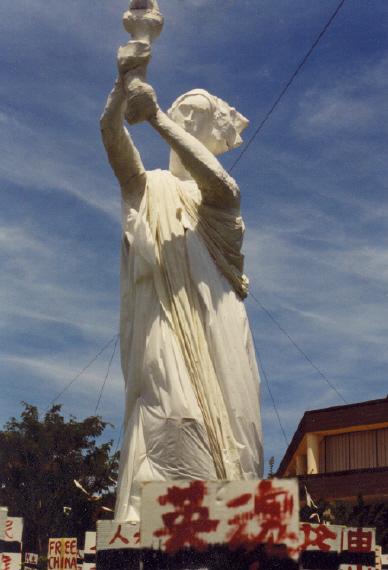
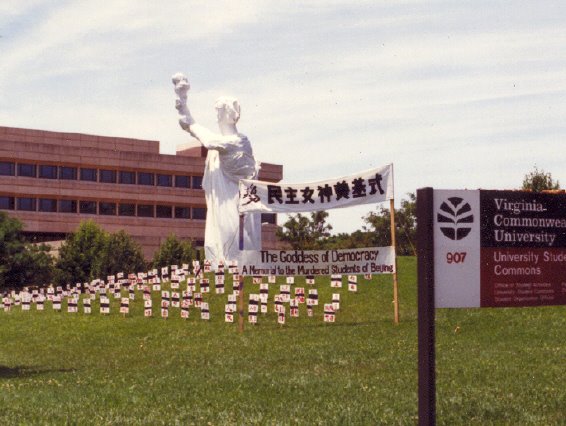
VCU's Goddess of Democracy

http://photos1.blogger.com/blogger/6291/212/1600/GoddessDemoc1b.jpg

Commentary by F.T. Rea

Built by art students, on May 30, 1989, the Goddess of Democracy was erected in Tiananmen Square as a symbol of their call for democratic reforms in China. The gathering protest in Tiananmen Square had begun in mid-April; tension was mounting.

Subsequently, on June 4, 1989, following orders, the People’s Liberation Army put an end to the demonstration. Mayhem ensued.

Although reports varied widely, hundreds, if not thousands, were killed. Made of chicken wire and plaster the Goddess was destroyed during the brutal routing of the protesters that had remained to the end, in defiance. As the drama played out on television, via satellite, the events shocked the world.

As their art student counterparts in China had been murdered in the shadow of their 33-foot-tall sculpture, in Richmond a group of VCU-affiliated artists heard the call of inspiration to stand with those who had fallen. They knew they had to build a replica of the lost Goddess.

The impromptu team of the willing and able worked around the clock for the next couple of days to give form to their tribute to the courage of those who had perished for freedom of expression. While the project was not sponsored by the school, wisely, VCU did nothing to discourage the gesture.

Richmond’s Goddess of Democracy (pictured above and below) stood the same height and was made of the same basic materials as the one in China had been.

Twenty-three years ago, facing Main Street, it stood as a memorial for about a month in front of the student center. CNN had a report on it, as did many other news agencies. Its image was on front pages of newspapers all over the world.

The little placards on sticks that surrounded the sculpture were added a few days after the Goddess was completed. Art-wise, it was one of the coolest things ever to happen in the Fan District and, to my knowledge, nobody made a penny out of it. It was constructed and maintained entirely by volunteers.

It was also a wonderful illustration of how traditional left and right, liberal and conservative, characterizations of all things political don’t always do justice to the truth of a situation. Was the stubborn and heavy-handed Chinese government standing to the right, or to the left, of the upstart students calling for reform?

When communists are the conservatives clinging to the old way, how does that play out on a spectrum of left-to-right thinking?

In 1989 I couldn't believe the university and the City of Richmond were allowing it. There must have been a thousand regulations and liability concerns that went overlooked, because of the righteousness of the undertaking.

The Goddess of Democracy on VCU’s campus in 1989 was the most successful piece of guerilla art this scribbler can remember having seen.

http://photos1.blogger.com/blogger/6291/212/1600/GoddessDemoc2a.jpg

The June 16 -30, 1989 issue of SLANT ran a story about building of the Goddess, which included the text of a handbill that I found posted at the site of the VCU memorial. Here's part of what it said: 
On May 13, 1989, Beijing University students began an occupation of Tiananmen Square to call for democratic reforms and an end to official corruption. The ensuing peaceful and often festive protest drew world attention and gained support from the citizens and workers of Beijing. On Sunday, June 4, at 3:30 [a.m.] Chinese time, troops of the 27th Division of the People’s Liberation Army entered the square with orders to disperse the students. At approximately 6 a.m. these same troops attacked the protestors with automatic weapons, tanks, and bayonets. According to government estimates only 300 students were killed, but local medical estimates put the death toll between 500 and 1,000.
The brutal suppression of unarmed students by a powerful totalitarian government has moved the world’s conscience. Many of the Tiananmen victims were art students who aspired to same basic freedoms which we enjoy daily. As American artists we cannot overlook, and we must never forget, the suffering and sacrifice of our brothers and sisters in Beijing. Their peaceful struggle was a cry for human rights everywhere, and their symbol, the Goddess of Democracy, was the highest artistic tribute they could pay to humanity’s noblest ideal -- freedom.
-- Photos by F.T. Rea