Monday, May 26, 2014

The Fan District's Goddess of Democracy

http://photos1.blogger.com/blogger/6291/212/1600/GoddessDemoc1b.jpg

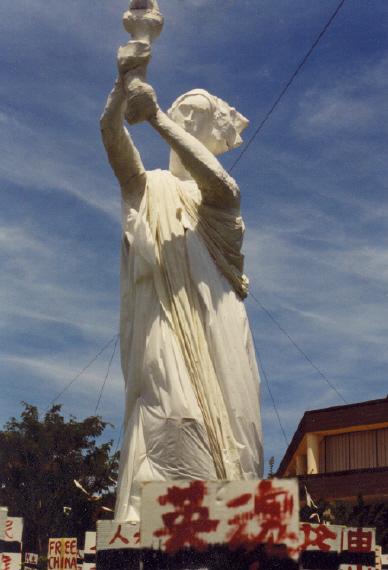
Twenty-five years ago, this week, the Goddess of Democracy was erected in Tiananmen Square. Made of chicken wire, papier mâché and plaster, it was built by art students. It symbolized their call for democratic reforms in China. The protest in Tiananmen Square had begun in mid-April; tension was mounting.

Subsequently, on June 4, 1989, following orders, the People’s Liberation Army put an end to the demonstration. Mayhem ensued. Although reports varied widely, hundreds, if not thousands, were killed. The Goddess of Democracy was destroyed during the routing of the protesters that had remained to the end, in defiance. As the drama played out on television, via satellite, the events shocked the world.

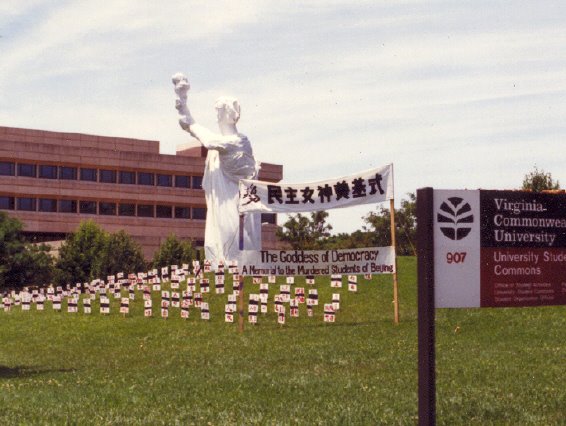
As their art student counterparts in China had been murdered in the shadow of their 33-foot-tall sculpture, in Richmond a group of VCU-affiliated artists heard the call of inspiration to stand with those who had fallen. They decided to build a replica of the lost Goddess.

The impromptu team of the willing and able worked around the clock for the next couple of days to give form to their tribute to the courage of those who had perished for the sake of freedom of expression. While the project was not sponsored by the school, wisely, VCU did nothing to discourage the gesture.

The Fan District's Goddess of Democracy (pictured above and below) stood the same height and was made of the same basic materials as the one in China had been. Facing Main Street, it stood as a memorial for about a month in front of the student center. CNN had a report on it, as did many other news agencies. Its image was on front pages of newspapers all over the world.

http://photos1.blogger.com/blogger/6291/212/1600/GoddessDemoc2a.jpg

The little placards on sticks that surrounded the sculpture were added a few days after the Goddess was completed. While it was easily one of the coolest things ever to happen in the Fan District, art-wise, but to my knowledge, nobody made a penny out of it. It was constructed and maintained entirely by volunteers.

It was also a wonderful illustration of how traditional right and left, liberal and conservative, characterizations of all things political don’t always do justice to the truth of a situation. Was the stubborn and heavy-handed Chinese government standing to the right, or to the left, of the upstart students calling for reform? When communists are the conservatives clinging to the old way, how does that play out on a spectrum of left-to-right thinking?

In 1990 I published a piece in SLANT to commemorate the first anniversary of the building of VCU's Goddess. In the article I inserted the text of a handbill that I had found posted at the site of the memorial the year before:
"On May 13, 1989, Beijing University students began an occupation of Tiananmen Square to call for democratic reforms and an end to official corruption. The ensuing peaceful and often festive protest drew world attention and gained support from the citizens and workers of Beijing. On Sunday, June 4, at 3:30 [a.m.] Chinese time, troops of the 27th Division of the People’s Liberation Army entered the square with orders to disperse the students. At approximately 6 a.m. these same troops attacked the protestors with automatic weapons, tanks, and bayonets. According to government estimates only 300 students were killed, but local medical estimates put the death toll between 500 and 1,000.

"The brutal suppression of unarmed students by a powerful totalitarian government has moved the world’s conscience. Many of the Tiananmen victims were art students who aspired to same basic freedoms which we enjoy daily. As American artists we cannot overlook, and we must never forget, the suffering and sacrifice of our brothers and sisters in Beijing. Their peaceful struggle was a cry for human rights everywhere, and their symbol, the Goddess of Democracy, was the highest artistic tribute they could pay to humanity’s noblest ideal -- freedom."

Also in that week's issue of SLANT were stories of a lighter nature. There was a piece about the then-bubbling NEA/Mapplethorpe controversy that had Sen. Jesse Helms flapping in the breeze. There was coverage of the Fan District Softball League -- the Bamboo Cafe led the Mars Division; Chetti’s led the Jupiter Division. Among that issue's advertisers were: 353-ROCK, Blab Television, the Brass Knocker, Brown Distributing, Bug Haus, Chetti’s, the Fan Market, Paradise Cafe, Price’s Market, Soble’s and South of the James.

The Goddess of Democracy on VCU’s campus in 1989 was the most successful piece of guerilla art I have seen in my travels.

-- My photos.

Friday, May 9, 2014

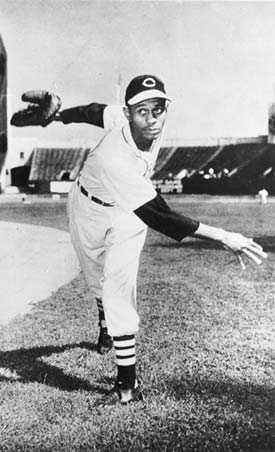
Leroy 'Satchel' Paige at Parker Field

Satchel Paige as a Cleveland Indian
With all the talk about where to play professional baseball in Richmond, I can’t help but think of Parker Field, which was a temple of baseball in my youth. So I can't swear some tiny part of my opposition to building a new stadium in Shockoe Bottom doesn't stem from my warm memories of people and events at Parker Field, which was located where the Diamond is now.

Parker Field opened in 1954 to serve as home for a new International League club — the Richmond Virginians. The Baltimore Orioles (formerly the St. Louis Browns) joined the American League that year, leaving an opening in the IL for the Richmond entry. Most fans called them the "V's."

As the V’s were one of the New York Yankees’ Triple A farm clubs, in those days the Bronx Bombers paid Richmond an annual visit in April. Just before Major League Baseball’s opening day, Mickey Mantle, Yogi Berra, Whitey Ford and the other great Yankees of that era would play an exhibition game in Richmond against V’s. It was always a standing-room-only affair.

Other than the pinstripe-clad hometown V’s my favorite club of the IL then was the pre-revolution Havana Sugar Kings. They played with an intensity, bordering on reckless abandon, it made them a lot of fun to watch, especially for the kids.

One of my all-time favorite pitchers I saw at Parker Field was Leroy “Satchel” Paige (1906-82). Yes, the legendary Paige, with his windmill windup, high kick and remarkably smooth release still working for him, plied his craft on the mound here in Richmond to the delight and other reactions of local baseball fans.

In 1971, Paige (pictured above, circa 1949) was the first of the Negro Leagues’ great stars to be admitted to Major League Baseball’s Hall of Fame, based mostly on his contributions before he helped break the Major League color line in 1948, as a 42-year-old rookie. The statistics from his pre-Big League days are mind-boggling. It's been said he won some 2,000 games and threw maybe as many as 45 no-hitters.

Furthermore, long before the impish boxer/poet Muhammad Ali, there was the equally playful Satchel Paige, with his widely published Six Guidelines to Success:  
  • Avoid fried meats that angry up the blood.
  • If your stomach disputes you, lie down and pacify it with cool thoughts. 
  • Keep the juices flowing by jangling gently as you walk. 
  • Go very lightly on the vices, such as carrying-on in society - the society ramble ain’t restful. 
  • Avoid running at all times. 
  • Don’t look back, something may be gaining on you.

Long after his days as the best pitcher in the Negro Leagues, following his precedent-setting stint in the American League, Paige was on the roster of the Miami Marlins (1956-58). Like the V’s the Marlins played in the International League. When I saw him Paige was in his 50s. Not in the starting rotation, anymore, he mostly worked out of the bullpen.

In the 1950s live professional baseball in Richmond was mostly a white guys’ scene. Which meant the boos would start as soon as the crowd noticed Paige’s 6-3, 180-pound frame warming up in a game's late innings. When he’d be called in to pitch the noise level would soar. Not all the grown men booed, but many did. That, while their children and grandchildren were split between booing, cheering, or embarrassed and not knowing what to do.

Naturally, some of the kids liked seeing the grownups getting unraveled, so Paige was all the more cool to them. Sadly, for some white men in Richmond, then caught up by the thinking that buoyed Massive Resistance, any prominent black person was seen as someone to be against. So, they probably would have booed Duke Ellington or A. Philip Randolph, too.

The showman Paige would take forever to walk to the mound from the bullpen. His warm-up pitches would each be big productions, with various slow-motion full windups. Then the thrown ball would whistle toward home plate with a startling velocity, making some of the kids cheer and laugh ... to mix with the boos.

 
Paige as a Miami Marlin in the 1950s

Paige, from Mobile, Alabama, must have understood what was going on better than most who were watching him perform. He was a seasoned veteran who knew perfectly well there wasn’t much he could do to change the boos; they were coming from folks trapped in the past. Alas, a past for Richmond that only a hundred years before Paige was on the mound at Parker Field included a busy slave market in Shockoe Bottom.

So, Paige played to the cheers, as experience over time had taught him to do. Of course, as a 10-year-old I lacked the overview that what I was seeing was an aspect of the difficult changes the South was going through, to do with race.

My guess is few spectators at the time grasped that the reaction to Paige, largely being split on generational lines, was a signal of how America’s baseball fans were going to change -- one day Jim Crow attitudes would have no place at baseball temples.
Now, with the benefit of decades of reflection, I understand that Satchel Paige was a visionary. He was seeing the future by following his own advice -- Don’t look back.

– Images from satchelpage.com

Monday, April 21, 2014

Too Many Secrets

The headlines for two seemingly unrelated news stories danced above the folds of America’s daily newspapers during 2013. One evoked the familiar haunts of a 50-year-old murder. The other revealed some details about overreaching surveillance having been conducted by the government. Our government.

Both stories brought to mind the countless troubles trying to keep too many secrets under wraps can set in motion. 

On Nov. 22, 2013 the 50th anniversary of the assassination of President John F. Kennedy was observed. For the school children of 1963 that sucker punch was stunning in a way nothing has been since.

The President's Commission on the Assassination of President Kennedy, better known as the Warren Commission, published its report on Sept. 24, 1964: Lee Harvey Oswald was found to have been a lone wolf assassin. Since he was put down by a self-styled executioner two days after Kennedy fell, the commission’s investigators never heard Oswald's testimony.

Much of how those investigators operated and too much of what they found was kept in the dark. Unfortunately, the cloaked-in-secrecy aftermath of the JFK assassination created a void that attracted speculation. Some aspects of the Warren Commission’s findings were puzzling. For instance, its famous “single bullet theory” had one projectile traveling circuitously, almost magically, through two victims.

In 1965 gunmen murdered Malcolm X in an auditorium in Manhattan. A sniper killed Martin Luther King as he stood on a motel balcony in Memphis in 1968. Two months after that Robert F. Kennedy was gunned down in a Los Angeles hotel. Unfortunately, the official stories on those three shootings were widely disbelieved, too. Everything baby boomers have seen since this tumult has been tinted by the cynicism it spawned.

More scrutiny of how those assassination inquiries were conducted might have led to different conclusions. Moreover, even if casting more sunlight on those probes had yielded no significant changes in the bottom lines, millions of citizens would surely have felt more comfortable about the good faith of the processes.

It took revelations that spoke of bad faith to steer us away from blithely tolerating so much secrecy. Among them were: the My Lai Massacre horrors; the publishing of the Pentagon Papers; the Watergate Scandal hearings; the Iran-Contra Scandal hearings; the bogus justification for invading Iraq.

Over the years such revelations changed America. Perhaps led by the baby boomers we have become a people who expect their government to lie. We also expect to be subjected to a steady stream of lies every day from advertising for mammoth corporations -- companies that, like our government, routinely spy on us.

It’s no wonder that today there are those who see fugitive whistleblower Edward Snowden as a hero. He revealed to many of them that the Patriot Act of the Bush administration's era wasn't so much about promoting patriotism. It was about spying. Some people who read the news regularly already knew that.  

Nonetheless, Snowden’s stunt put him on the celebrity map. By simultaneously leaking classified information about how far-flung our government’s surveillance has been and going on the lam, Snowden instantly became the darling of at least two large groups: 1. Government haters, in general. 2. Folks who like pouring pop culture into their tall glasses of politics, like a soft drink mixer.

To a third group, Snowden’s weak imitation of some previous brave whistleblowers has been at least as annoying as it has been edifying. Still, Snowden does deserve plenty of credit for launching new discussions of how much spying, by any entity, we the people should countenance.

Which, right away, leads straight to one galling conclusion: to some extent, spying is here to stay. If you use credit cards, cell phones and the Internet you're going to be tracked. Plus, the practice of security cameras and phone cameras recording images of everything is only going to increase.

So, rather than bellyaching about officials watching us, what we should be doing is demanding to watch the watchers. We should be calling for sunlight into the operation of governments at all levels. We should insist on knowing the sources of all the money flowing into elections and lawmaking. We should be able to see through corporate veils that hide malfeasance, too.

We can also try to outlaw some kinds of information gathering. Maybe that will work, but it’s more important to accept that privacy, in its old fashioned sense, is a horse that left the barn years ago. Wise up, rather than dwelling on protecting an individual's privacy -- secrets, again -- society's more important need is for openness where it counts most.

Truth is more important than privacy. Sunlight should be a big political issue of this election year, maybe the biggest. But it probably won't be, because the people financing political campaigns don't want it to be. 

Single Bullet Theory?

Great name for a band.

-- 30 --

Thursday, April 17, 2014

Unmuzzling the Voters Is a Worthy Cause


In 2009 I covered the baseball stadium debate for Richmond.com. What I wrote in the way of analysis made no secret of my skepticism about the merits of the $783 million Highwoods Properties development plan, which included what it called Shockoe Center.

Five years ago I saw building a baseball in Shockoe Bottom as another build-it-and-they-will-come folly in the making. When the Highwoods plan was withdrawn from consideration that summer I was delighted. Thus, my opposition to building a baseball in the Bottom is nothing new. So much for disclosure.

Five months ago, when Mayor Dwight Jones' announcement revived the twice-killed idea of dropping a baseball stadium into that same neighborhood, it was disappointing. Although Jones once favored keeping professional baseball on the Boulevard, I won't try to explain his squirrelly change of mind.

However, my own thinking about the issue has evolved in the opposite direction. Since the critical and box office success of the Oscar-winning film, “12 Years a Slave” (2013), Richmond's slave jail history leading up to the Civil War has become more interesting to a lot of people, here and elsewhere. No doubt, there are folks at City Hall who wish that movie’s release could have been delayed a year or two.

Having grown up in Richmond, I’d like to better understand the slave market business that once thrived in this city. Accordingly, I’d also like to learn more about how that aspect of local history was rather effectively covered up for so long. Regarding the institution of slavery, it's time to shine a new light on how our history books were cooked, back in the day. A fresh look needs to be taken at how the truth was systematically processed into palatable lies -- denial.

For instance, in 1961 my seventh-grade history book, which was used in all of Virginia's public schools, had this to say at the end of Chapter 29: 
Life among the Negroes of Virginia in slavery times was generally happy. The Negroes went about in a cheerful manner making a living for themselves and for those whom they worked. They were not so unhappy as some Northerners thought they were, nor were they so happy as some Southerners claimed. The Negroes had their problems and their troubles. But they were not worried by the furious arguments going on between Northerners and Southerners over what should be done with them. In fact, they paid little attention to those arguments.
In 2014, to think building a baseball stadium in Shockoe Bottom will really facilitate the scholarly investigation of that neighborhood’s history and archeology is just more denial.

Please do put me on the growing list of those who believe a world-class slavery museum in Shockoe Bottom, sans ballpark, will draw tourists from all over the world. Still, I don’t quarrel with those who oppose baseball in the Bottom for other reasons. Richmond residents who oppose building a new stadium anywhere, saying that with schoolhouse roofs caving in taxpayers ought not to spend another nickel on spectator sports, have a good point. Those who assert that a lot of Flying Squirrels fans aren't likely to go to the Bottom for games probably know more about local baseball fans than the mayor does. 

So now I've become a member of an ad hoc group which advocates letting the voters weigh in. Although the Citizens Referendum Group has to collect a whopping 9,800 signatures on its referendum petitions, advocates for building Shockoe Stadium who stand opposed to our petition drive have a tough job on their hands, too. They have to convince voters that too much democracy can be a bad thing.

My personal reason for having taken up this cause stems, in part, from being asked to write a story about a benefit show in December for STYLE Weekly. Click here to read my review of the “Billy Ray Hatley Tribute Concert at the National.” After spending the afternoon backstage, watching the musicians and stage hands put the complicated show together, and then being there for the show to feel the vibe from the connection between those on stage and in the audience, I was knocked out.

The common desire to celebrate Hatley’s contributions as a musician/songwriter and to help out his family was uplifting. Filled with admiration for the effort it took to put that show together, I decided to act on something that I had been fretting about for months.

As a co-founder of the Facebook group Referendum? Bring It On!, my pump had been primed by the discussions that followed the failed referendum attempt last summer by Charles Samuels, the Second District's representative on City Council. When I saw the slick Loving/RVA public relations campaign come out, I realized that without a hard pushback from propaganda-savvy people, the developers would win this time around.

After so many years of watching the parade go by and making my wisecracks as a commentator, I decided to cross the line and become an activist. For a worthy cause, I decided to take on the rather frustrating job of helping to assemble a group of people to put a referendum on the ballot.

A meeting was held later in December at Gallery 5. The concept continued to take form with posts by several people on the Facebook page. In February Reva Trammell called for a referendum at a Council meeting. Then Don Harrison asked me to appear on WRIR’s Open Source show to talk about a referendum. Paul Goldman called with an offer to write the language for a referendum and the suggestion of a meeting to discuss the project. Subsequently, there was a series of meetings at the Main Library during March.

At the third meeting Goldman handed out court-approved petition forms with two propositions on them. Members of the group left the confab determined to get the job done. As April began the CRG’s website went live. After a decade of hearing from boosters and experts and politicians, we are working to let the people speak. Join us, if you like.

Now, I'll close with two questions: Who’s against democracy and why?

Friday, February 28, 2014

Who's Against Democracy?


When a high-profile controversy flaps in the breeze, unresolved for a decade, it can take on a life of its own. So it has been for Richmond’s dilemma concerning where minor league baseball should be played. 

For many Richmonders the baseball stadium issue has become frustrating in a way unlike any other they can remember. It hasn't been difficult to get the idea that a few hungry developers have been intimidating local officials to acquiesce to their wishes. 

When the stadium brouhaha started 10 years ago, for me, the thing that stood out was the talk about professional baseball coming from folks who seemed to know little about it. Gradually that morphed into how wrongheaded the baseball in the Bottom concept was, from a practicality standpoint. Maybe John McEnroe said it best, "You cannot be serious!"

Then it got to be more about Shockoe Bottom’s remarkable history; I grew up in Richmond and recent revelations about the slave market have amazed me. I've come to understand that what was buried in Shockoe Bottom after the Civil War was deliberately covered up. It's turned out to be another layer of denial. How in good conscience can we go on averting our eyes from what really happened in those slave jails? From how many there were?

Now, for me, it’s come down to being about democracy, too. Maybe that's the trump card in this game.

You see, on this issue I’ve become convinced the local politicians aren’t speaking for the people that voted them into office. And, they know it. It's hardly unfair to say the PR team pushing the scheme to shoehorn a stadium into the Bottom isn't speaking for anything but money. The forces for baseball in the bottom love to characterize their opposition as being mostly the sort of activists who not only oppose baseball in the Bottom, but everything any government does. But in this case the aroused activists who've been demonstrating in front City Hall are just the tip of the oppositional iceberg.

Over the long haul the combination of voices, all trying to speak over one another, has become a numbing cacophony. It has become a pestering wall of noise in our lives. Given that, when it comes to the stadium issue, who is now speaking for John Q. Public? 

A citizens referendum would speak for those who care enough to vote. Put it on the ballot and let all the campaigners push for their side as hard as they like. Only such a referendum on whether to build a stadium in Shockoe Bottom, or not, can settle this matter in a satisfying way.

With a referendum on the ballot the school children in Richmond would have a splendid opportunity to learn a civics lesson about what it really takes to keep a democracy working properly.

Generally speaking, politicians don't like referendums that come up from citizens' groups. In Richmond they've made it hard to do. Nonetheless, while it won't be easy to get the question on the ballot in November, it can be done. In Virginia citizens can write laws. It will take a serious petition-signing campaign to drive a stake into the heart of baseball in the Bottom. But it can be done.

And, if the baseball in the Bottom forces swell up and get the majority of the votes, I won't like it, but the will of the people is a righteous thing. Moreover, I'm not scared.

OK. Who's against democracy? 

Wednesday, February 19, 2014

A Prank for the Ages: Biograph's 2nd Anniversary (1974)

Detail from 1974 Staff Art Show sign
by F.T. Rea 

On a pretty day in July of 1971, I went to a construction site on the north side of the 800 block of West Grace Street. It was mostly a big hole in the orange ground between two old brick houses. A friend had tipped me off that she’d heard the owners of the movie theater set to rise from that hole were looking for a manager who could write about movies. Most importantly, she said they wanted to hire a promotion-savvy local guy.

Chasing the sparkle of that opportunity I met David Levy at the construction site. He was the Harvard-trained attorney who managed the Biograph Theatre at 2819 M Street in Washington. D.C.

Levy was one of a group of five men who had opened Georgetown’s Biograph in what had previously been a car dealership in 1967. Although none of them had any experience in show biz, they were smart young movie lovers whose timing had been impeccable -- they caught a pop culture wave. The golden age of repertory cinema was waxing and they picked the right town.

With their success in DeeCee a few years later they were looking to expand. In Richmond’s Fan District they thought they had discovered the perfect neighborhood for a second repertory-style cinema.

A pair of local players, energy magnate Morgan Massey and real estate deal-maker Graham “Squirrel” Pembroke, acquired the land. They agreed to build a cinderblock building just a stone’s throw from VCU’s academic campus for the Biograph partners to rent. The cinema's owners had decided to use the same longtime cinema-related name in Richmond as they had in Georgetown. If it was good enough for D.W. Griffith it was good enough for them a second time.

Some 10 weeks after my first meeting with Levy he offered me the manager’s position. I don’t remember how many competitors he said I beat out, but I can remember trying not to reveal just how thrilling the news was. At 23-years-old, I couldn’t imagine there was a better job to be had in the Fan District. At the time I was working for a radio station, so I had to keep it a secret for a while.

Levy and I got along well right away and we became friends who trusted one another. He and his partners were all about 10 years my senior.

Three years after Richmond Professional Institute and the Medical College of Virginia had merged to become Virginia Commonwealth University in 1968, there were few signs of the dramatic impact the university would eventually have on Richmond. Although film societies were thriving on campus in 1971, the school was offering little in the way of classes about movies or filmmaking. A few professors occasionally showed artsy short films in their classes.

Mostly, independent and foreign features didn’t come to Richmond. So, in 1971, the coming of the Biograph Theatre to Grace Street offered hope to optimistic film buffs that even in conservative Richmond the times were indeed a-changing.

My manager’s gig lasted until the summer of 1983. Grace Street’s Biograph Theatre closed four years later. A hundred miles to the north the Biograph on M Street closed in 1996. David Levy died in 2004.

In 2014 there’s a noodles eatery in same building that once housed the repertory cinema I managed for 139 months. Now it’s the oldest building on the block.


On the evening of Friday, February 11, 1972, the venture was launched with a gem of a party. In the lobby the dry champagne flowed steadily as the tuxedo-wearers and those outfitted in hippie garb happily mingled. A trendy art show was hanging on the walls. The local press was all over what was an important event for that bohemian commercial strip. The feature we presented to the invited guests was a delightful French war-mocking comedy — “King of Hearts” (1966); Genevieve Bujold was dazzling opposite the droll Alan Bates.

With splashy news stories about the party trumpeting our arrival the next night we opened for business with a double feature: “King of Hearts“ was paired with “A Thousand Clowns“ (1965). Every show sold out.

The Biograph’s printed schedule, Program No. 1 was heavy on documentaries. It featured the work of Emile de Antonio and D.A. Pennebaker, among others. Also on that program, which had no particular theme, were several titles by popular European directors, including Michaelangelo Antonioni, Costa-Gavras, Federico Fellini, and Roman Polanski.

Like the first one, which offered mostly double features, each of the next few programs covered about six weeks.

Baby boomers who had grown up watching old movies on television had learned to worship important movie directors. Knowing film was cool; it could get you laid.

The fashion of the day elevated certain foreign movies, selected American classics, a few films from the underground scene, etc., to a level above most of their more accessible Hollywood counterparts. As I read everything I could find about what was popular, film-wise, in New York and San Francisco I learned the in-crowd viewed most of Hollywood’s then-current products as either laughingly naive or hopelessly corrupt.

Or both.

What my job would eventually teach me was how few people in Richmond actually saw it that way in 1972. After the opening flurry of interest in the new movie theater, with long lines to nearly every show, it was surprising to me when the crowds shrank dramatically in the months that followed.

As VCU students had been a substantial portion of the theater’s initial crowd the slump was chalked off to warm weather, exams and then summer vacation. In that context the first summer of operation was opened to experimentation aimed at drawing customers from beyond the immediate neighborhood.

That gave me an opportunity to do more with a project Levy had put me in charge of developing, using radio to promote it -- Friday and Saturday midnight shows.

By trial and error we learned it took an offbeat movie that lent itself to promotion. Early midnight show successes were “Night of the Living Dead” (1968), “Yellow Submarine” (1968), “Mad Dogs and Englishmen” (1971), and an underground twin bill of “Chafed Elbows” (1967) and “Scorpio Rising” (1964).

With significant input from the theater’s assistant manager, Chuck Wrenn, who was a natural promoter, off-the-wall ad campaigns were designed in-house. There were two essential elements to those promotions:
  • Wacky radio spots had to be created and run on WGOE, a popular AM station aimed directly at the hippie listening audience.
  • Distinctive handbills needed to be posted on utility poles, bulletin boards and in shop windows in high-traffic locations.

Dave DeWitt produced the radio commercials. In his studio, Dave and I frequently collaborated on the making of those spots over six packs of Pabst Blue Ribbon. Most of the time we went for levity, even cheap laughs. Dave was masterful at producing radio commercials; the best I‘ve ever met.

Now DeWitt lives in New Mexico and is known as the Pope of Peppers. He has written dozens of cookbooks and countless articles about food.

Handbill for the event
On September 13, 1972, a George McGovern-for-president benefit was staged at the Biograph. Former Gov. Doug Wilder, then a state senator, spoke. We showed "Millhouse" (1971), a documentary that put President Richard Nixon in a bad light.

Yes, I had been warned that taking sides in politics was dead wrong for a show business entity in Richmond. Taking the liberal side only made it worse. But the two most active partners who were my bosses, Levy and Alan Rubin, who was a geologist turned artist, were delighted with the notion of doing the benefit. They were used to doing much the same up there. So with the full backing of the boys in DeeCee I never hesitated to reveal my left-leaning stances on anything political.

Also in September “Performance” (1970), a somewhat overwrought but well-crafted musical melodrama -- starring Mick Jagger -- packed the house at midnight three weekends in a row. Then a campy, docu-drama called “Reefer Madness” (1936) sold out four consecutive weekends.

The midnight shows were going over like gangbusters. To follow “Reefer Madness” what was then a little-known X-rated comedy, “Deep Throat” (1972), was booked as a midnight show. While we had played a few films that were X-rated, this was our first step across the line to hardcore porn.

As “Deep Throat” ran only an hour, master prankster Luis Buñuel’s surrealistic classic short film (16 minutes), “Un Chien Andalou” (1929), was added to the bill, just for grins. Although I can’t remember whose idea it was to play “Deep Throat” in the first place, it may have been mine. But I’m pretty sure it was Levy who wanted to add “Un Chien Andalou” to the bill.

It should be noted that like "Deep Throat," Buñuel’s first film, was also called totally obscene in its day. Still, this may have been the only time that particular pair of outlaw flicks ever shared a billing ... anywhere.

A few weeks after “Deep Throat” began playing in Richmond, a judge in Manhattan ruled it was obscene. Suddenly the national media became fascinated with it. The star of "Deep Throat," Linda Lovelace, appeared on network TV talk shows. Watching Johnny Carson pussyfoot around the premise of her celebrated “talent” made for some giggly moments.

Eventually, to be sure of getting in to see this midnight show, patrons began showing up as much as an hour before show time. Standing in line on the brick sidewalk for the spicy midnight show frequently turned into a party. There were nights the line resembled a tailgating scene at a pro football game. A determined band of Jesus Freaks took to standing across the street to issue bullhorn-amplified warnings of hellfire to the patrons waiting in the midnight show line that stretched west on Grace Street. It only added to the scene.

Playing for 17 consecutive weekends, at midnight only, “Deep Throat” grossed over $30,000. That was more dough than the entire production budget of what was America’s first skin-flick blockbuster.

The midnight show’s grosses conveniently made up for the disappointing performance of an eight-week program of venerable European classics at regular hours. It included ten titles by the celebrated Swedish director, Ingmar Bergman. The same package of art house workhorses played extremely well up in Georgetown, underlining what was becoming a painfully underestimated contrast in the two markets.

Handbill for the Richmond premiere in 1973

Even more telling, over the early spring of 1973 a series of imported first-run movies crashed and burned. The centerpiece of the festival was the premiere of the Buñuel masterpiece, “The Discreet Charm of the Bourgeoisie” (1972). In what Levy and I then regarded as a coup, gambling it would win the Best Foreign Film Academy Award, he booked it in advance to open in Richmond two or three days after the Oscars were to be handed out.

We had guessed right, “The Discreet Charm of the Bourgeoisie” took the Oscar, but it flopped in Richmond. The one-year-old cinema’s management team was more than bummed out.

We were stunned by the extent of our miscalculation.

Money had been put up in advance to secure a print, which was in demand because it was doing brisk business in most other cities. The failure of this particular booking and the festival that surrounded it finally forced a serious reassessment of what had been the original plan. The Georgetown Biograph couldn’t prop up its Richmond counterpart forever.

*

To stay alive Richmond’s Biograph needed to make adjustments in it’s booking philosophy. After much fretting on the phone line between M Street and Grace Street the Faustian deal was struck -- another film was booked that had been made by the director of “Deep Throat,” Gerard Damiano. Significantly, this time the picture's distributor imposed terms calling for “The Devil in Miss Jones” (1973) to play as a first-run picture at regular show times, every night, rather than as a midnight-only attraction.

At this point no one could have anticipated what we were setting in motion by agreeing to expand the availability of “adult movies” beyond the midnight hour. As we hadn't been promoting our midnight shows in the same way we did our regular fare, for the first time the title and promotional copy for a skin flick was included on a Biograph program.

Then an aggressive young TV newsman took Biograph Program No. 12 to Richmond's new Commonwealth’s Attorney, Aubrey Davis. The reporter asked Davis what his office was going to do about the Biograph’s brazen plan to run such a notorious film, especially in light of the then-freshly-minted Miller Decision on obscenity by the Supreme Court. (Miller basically allowed communities to set their own standards for obscenity.)

Eventually, the provocateur got what he wanted from the prosecutor -- a quote that would fly as an anti-smut sound bite. Other local broadcasters jumped on the bandwagon the next day. By the mid-summer evening “The Devil in Miss Jones” opened in Richmond it had already become a well-covered story.

Once again I saw what publicity could do. Every show sold out and a wild ride began. Matinees were added the next day.

On the third day all the matinees sold out, too. By the fourth day the WRVA-AM traffic-copter was hovering over the Biograph in drive time, giving live updates on the length of the line waiting to get into the theater. The airborne announcer helpfully reminded his listeners of the upcoming show times.

Well, that did it!

The following morning a local circuit court judge asked for a personal look at what was clearly the talk of the town. Management cooperated with his honor’s wishes and the print was schlepped down to Neighborhood Theaters’ private screening room, at 9th and Main Streets, for the convenience of the judge.

As Judge James M. Lumpkin admittedly hadn’t been out to see a movie in a theater since sometime in the 1950s, this particular moving picture rubbed him in the worst way. Literally red-faced after the screening, the outraged judge looked at Levy and me like we were from Mars.

Maybe Pluto.

Lumpkin promptly filed a complaint with the Commonwealth’s Attorney and set a date for issuing a Temporary Restraining Order, to halt further showings as soon as possible.

The next day a press conference was staged in the Biograph’s lobby to make an announcement.

Every news-gathering outfit in town bought the premise and sent a representative. They acted as if what was obviously a publicity stunt was news because it served their purpose to play along. After DeWitt -- who was then representing the theater as its ad agent -- laid out the ground rules and introduced me to the working press, I read a prepared statement for the cameras and microphones. (No record of this performance is known to exist.)

The gist of it was that based on demand -- sellout crowds -- the crusading Biograph planned to fight the TRO in court. Furthermore, the first-run engagement of “The Devil in Miss Jones” would be extended -- it was being held over for a second week.

During the lively Q & A session that followed, when Dave scolded an eager scribe for going too far with a follow-up question, it was tough duty holding back the laughing fit that would surely have broken the spell we trying to cast over the reporters.

The TRO stuck, because Judge Lumpkin still had all the say-so. “The Devil in Miss Jones” grossed about $40,000 in the momentous nine-day run the injunction halted. Technically, the legal action was against the movie, itself, rather than anyone at the Biograph. Which obviously suited me just fine.

The trial opened on Halloween Day. Lumpkin served as the trial judge too. I was surprised that the person whose original complaint to the Commonwealth’s Attorney had set the whole process in motion could then hear the case. Objections to that affront to justice fell on Lumpkin’s deaf ears.

*

On November 13, 1973, Lumpkin put all on notice: If you dare to exhibit this “filth” to the public, then stand by for certain criminal prosecution. So it was that “The Devil” was banned by a judge in Richmond, Virginia.

The plot to answer the judge's decree was hatched in early January of 1974 in the office on the second story, next to the projection booth. Having finished the box-office paperwork, or whatever, I was browsing through a stack of newly acquired 16mm film catalogs.

As it was after-hours, the scent of recently-burned marijuana may have been in the air when a particular entry -- “The Devil and Miss Jones” -- jumped off the page. It was instantly obvious to me the title for that 1941 RKO light comedy had been the inspiration for the banned X-rated movie’s title -- “The Devil in Miss Jones.”

It should be noted that the public had yet to be subjected to the endless puns and referential lowbrowisms the skin-flick industry would eventually use for titles. This was still in what might be called the seminal days of the adult picture business. Culturally, because there was still a blur in the line between edgy underground films and outright porn the somewhat oxymoronic term "porno chic" was in currency. It didn't last long.

The prank's plan called for using the upcoming second anniversary as camouflage. Early on, DeWitt and the theater’s resourceful assistant manager, Bernie Hall, were in on the scheming/brainstorming in the office. Then, in a deft stroke -- suggested by Alan Rubin over the phone -- a Disney nature short subject, “Beaver Valley” (1950), was added to the birthday program, to flesh it out.

The stunt’s biggest problem was security. The whole scheme rested on the precarious notion that the one-word difference in the two titles, which spoke of the Devil's proximity to Miss Jones, simply wouldn’t be noticed. It was something like hiding in plain sight. We believed people would see what they wanted to see, but the staff fully understood the slightest whiff of a ruse would mean our undoing.

Thus, absolutely no one outside our group could be told anything. No one.

The Biograph announced in a press release on DeWitt’s ad agency letterhead that its upcoming second anniversary celebration would offer a free admission show. The titles, “The Devil and Miss Jones” and “Beaver Valley,” were listed with no accompanying film notes. Birthday cake would be free, too!

Somehow, a rumor began to circulate that the Biograph might be outmaneuvering the court’s decree by not charging admission. The helpful rumor found its way into print -- the street gossip section of The Richmond Mercury. I don't know if they knew what was really going on, or not.

The busier-than-ever staff fielded all inquires, in person or over the telephone, by politely reciting the official spiel, which amounted to: “We can tell you the titles and the show times. The admission will be free. No further details are available.”

The evening before the event the phones were ringing off the hook. Reporters were snooping about. One, in particular, stuck around trying to claw his way toward the key to the mystery. In the lobby, as I manned my familiar post at the turnstile, in a conspiratorial tone he said: “It has something to do with the title, doesn‘t it?”

Uh-oh! He was getting too close. To fend him off I decided to take a chance.

So, talking like one spy to another, I told the newsman that what was going to happen the next day would be a far better news story than a story of spoiling it the day before -- that is, if there really is a trick of a sort in the works.

Gambling that it would work, I asked him to leave it alone and trust that once it all unfolded he wouldn't regret it. Fortunately, he agreed to say nothing and he kept his word. His identity must remain a secret.

Feb. 11, 1974: 800 block of W. Grace St.
Up until the box office opened no one else outside our tight circle appeared to have an inkling of what was about to happen. Amazing as it may sound, the caper’s security was airtight. It was absolutely beautiful teamwork!

On the day of the event the staff decorated the lobby with streamers and balloons. We laid out the birthday cake. We tested the open keg of beer, just to make sure it was good enough for the patrons waiting in line to drink. Spurred on by hopes the Biograph was about to defy a court order, by lunch time the end of the line along Grace Street was already reaching Chelf's Drug Store -- which meant about 500 people.

It was suggested to me that we could eventually have a riot on our hands. What would happen if we lost control of the situation?

Nobody knew. That’s what made it so exhilarating!

My collaborators on the staff that one-of-a-kind night on the job were: Bernie Hall (assistant manager); Karen Dale, Anne Peet and Cherie Watson (cashiers); Tom Campagnoli and Trent Nicholas (ushers); Gary Fisher (projectionist). Some dressed up in costumes. Trent wore a clown mask. In case trouble broke out he wanted to be able to take it off and disappear into the lynch mob.

The box-office for the 6:30 p.m. show opened at 6 p.m. By then the line of humanity stretched almost completely around the block. It took every bit of a half-hour to fill our 500-seat auditorium. We turned away at least six or seven times that number.

The sense of anticipation in the air was electric as the house lights in the auditorium began to fade. Outside, on the sidewalk, many of those who couldn't get in to the first show stayed in line for the second show at 9 p.m.

The prank unfolded in layers. Some caught on and left while “Beaver Valley” was running. Most stayed through the first few minutes of “The Devil in Miss Jones.” Only about a third of the crowd remained in their seats through both movies. Afterward, there were lots of folks who said it was the funniest prank that had ever happened in Richmond.

Of course, a few hardheads got peeved. But since admission had been free, as well as the beer and cake, well, there was only so much they could say.

Even though those in line for the second show were told about the hoax by people leaving the first show, the second show packed the house, too. By then it seemed a lot of people just wanted to be in on a unique event, to see what would happen and be able to (honestly) say they were there.

The rush that came from living in the eye of that day’s storm of activity was intense, to say the least. After the second show emptied out, gloating over the utter success of the gag, as the staff and assorted friends finished off the second keg, was as good as it gets in the prank business.

The birthday cake was free while it lasted

Meanwhile, thoroughly amused reporters were filing their stories on what had happened at the Biograph. The next day wire services and broadcast networks picked up the story. We returned to business as usual with an Andy Warhol double feature.

A few days later NPR’s All Things Considered went so far as to compare the Biograph’s second anniversary prank to Orson Welles’ mammoth 1938 radio hoax. Which was fun to hear, but I had the good sense to tell the interviewer that in comparison our stunt was "strictly small potatoes."

Congratulatory mail came in from all over the country. Six months later the Biograph closed down for a month to be converted into a twin cinema. With two screens to fill the manager’s job became more complicated. As an independent exhibitor, prank or no prank, it wasn’t always easy to rent enough product to fill two screens. The repertory “mission” become increasingly blurred over the next few years.

Thinking back about what an effort it took just to keep the Biograph's doors open in those days, now it seems like it was all sort of an elaborate stunt … pranks for the memories.

*   *   *

Ed. Note: This piece is an excerpt of F.T. Rea's "Biograph Times," a work in progress, soon to be published.
Thursday, January 2, 2014

Paradise Unvarnished

Note: This piece was first published in SLANT in 1991.

No talent. It wasn’t easy to stomach. The public had no use for his 
 abstract expressionist paintings. They were too big for most walls. 
He’d be a has-been, except he never was. 

Uncle Dudley’s letter was still in his pocket. It said, “Come home to run the 
restaurant, or it’s going on the block February 1st. It’s time you should 
make a living, already. Either way, Rebus, I’m retiring." 
Could Rebus leave Key West? Face real winters?

 The temporary life of the aspiring artist/bartender/cab driver is better suited to 
the young Turk, still waiting for his ship to come in. Meanwhile, this old 
Turk hadn’t had a new idea in years. His opinion was stale. Out of 
schemes, Rebus sighed, polished off his beer and reached for another.

Dudley’s ultimatum. This was his ship coming in? After all the years of sweat and turpentine it looked more like a dinghy.

Like so many before him, Rebus had believed that once he finally got old 
enough to dwell on anything other than getting laid, his serious work 
would inevitably emerge.

On the road in South Carolina, he could see the plain truth. The artist scheme 
might have gotten more traction if he’d been half as talented as he’d been 
horny ... and maybe if he'd made smaller paintings.

--  Art and copy by F.T. Rea

Thursday, December 5, 2013

The Tenth Commandment

by F.T. Rea

Note: This piece was written in 1999, not long after the massacre at Columbine HS in Colorado. 

*

According to the Old Testament, Moses heard directly from God about standards of behavior. A portion of the instructions Moses is purported to have heard, The Ten Commandments, is still well known and occasionally finds its way into the news.

There were several other rules offered atop Mount Sinai that we hear less about. If you read much of the book of Exodus, it won’t take long for you to see why. Let’s just say that some are rather old world, including the regulation of established practices such as slavery and burnt offerings.

However, the Ten Commandments are made up of cut-to-the-chase basic stuff: honor your God and your parents; be willing to make sacrifices for what matters most to you; don’t kill, lie, or steal; don’t cheat on your spouse. Of course, in the time of Moses it depended on what “cheating” meant. In the final of the ten, Moses claimed God said people should not covet their neighbors’ goods.

After such a simple list of shalt-nots, the last rule is against even thinking about a shalt-not. It seems redundant. Covet?

Come on, Moses, what’s the problem here? What’s so bad about a little coveting? Why not stick to nine commandments?

Hopefully, the reader will permit the post-modern license for me to move directly from the Old Testament to a 1991 Hollywood thriller, in order to help Moses with his answer. In “Silence of the Lambs,” the brilliant but evil psychiatrist, Hannibal Lecter, instructs the movie’s detective heroine -- who is on the trail of a serial killer -- that people usually covet what see. Something they see all the time.

Bulls-eye!

Of course, the ravenous Dr. Lecter was right about what fuels cravings. If one hasn’t seen it, how can one lust for it? To obsessively want something unattainable, to the point of no return, one must see it regularly. Coveting is a festering in the mind; it's a craving for that which one cannot, perhaps should not, have. Dwelling on coveting can conjure up evil.

Today, because of the modern media, everyone sees how wealthy/powerful people live all the time. In addition to telling stories, one sure thing the movies, the sitcoms, the soaps and the celebrity news all do, is to show us how well off some people are.

Then every few minutes the advertisements tell us where to buy the same pleasures and accouterments the glittery stars in those stories own. If you’ve got the dough to buy the stuff, that’s one thing. If you don’t that’s another. Uh-oh!

The lifestyle of a celebrity is constantly sold to consumers as the good life. Wanting that good life is a carrot on the stick that helps drive our consumer culture. Therefore, in some ways, it has been good to all of us. My thesis for today’s rant is that there is an unintended side to this strategy to stimulate consumerism. A dark side.

When powerless/poor people see that same contrived entertainment, with product placements aplenty, they want the good life too. Of course they do. However, if they are trapped in their circumstances and have no hope they don’t believe the good life is available through legitimate channels. So, instead of feeling motivated to work overtime, to earn more money, the powerless are left to stew in their coveting juices.

Eventually all that desire for the unobtainable can lead to trouble. I’m convinced that some part of the violence we have seen from teen-agers, lately, stems from their exaggerated sense of powerlessness. In the worst cases, their impatience boils over while waiting for what they imagine to be an adult’s awesome power over life and death.

The good news is that kids grow up. Most of our children won’t shoot up their schools, because of their frustration with having so little say-so over their schedule. The bad news is that for many of the world’s underdogs their sense of powerlessness is something that isn’t going to dissipate so easily.

In the so-called Third World, the longings for First World goods and options grow every day. Powerless audiences are seeing the propaganda for the good life on television and the Internet every day. At the same time, living as they do, they don’t see a realistic way for them to get over being poor.

Fifty years ago the world's underclass wasn't wired into the rest of civilization. Now it is. Now everybody knows how soft life can be for the well-off, living in gated communities.

If those in the underclass look to history, they will see that the unwashed masses have usually had to take what they wanted by force. How much longer citizens of the First World can continue to placate the planet’s hungriest folks, to hold them at bay while politics and capitalism routinely grind up their hopes for a better life, is anybody’s guess.

In the meantime, perhaps the other side of “thou shalt not covet” is “thou shalt not flaunt.”

If the wisdom of the ages -- the Ten Commandments -- suggests it’s wise to eschew our own destructive cravings, perhaps we’d be smart not to shine our brightest spotlights on what encourages coveting in others.


-- 30 --

Note: A version of this piece was originally published by STYLE Weekly in 1999. The art is from a piece I did in a spell of Christmas-blues in 1982. 

Thursday, November 21, 2013

Fifty years after JFK’s murder it’s time to let sunlight change our ways

Camelot at 1600 Pennsylvania Ave lasted 1,036 days. For the children in school on Nov. 22, 1963, the murder of President John F. Kennedy was stunning in a way nothing has been since. The cynicism the cloaked-in-secrecy aftermath of the JFK assassination spawned has tinted everything baby boomers have seen 1963.

Shortly after JFK’s death, in lamenting the demise of Camelot, columnist Mary McGrory said to Daniel Patrick Moynihan: “We’ll never laugh again.”

Moynihan, who was an Assistant Secretary of Labor then, said, “Heavens, Mary, we’ll laugh again. It’s just that we’ll never be young again.”

On Nov. 24, 1963 a live national television audience witnessed the murder of the assassination’s prime suspect, Lee Harvey Oswald. There was no doubt that Jack Ruby, a Dallas nightclub operator, was the triggerman. What made him do it is still being questioned.

However, please don’t get me wrong. I’m not here to say there had to have been a complicated conspiracy to kill the president and cover up the tracks. After he was dead, just because some people deliberately obscured related information, we don't necessarily know why. In some cases it was probably people trying to cover selected asses for a myriad of reasons.

On the other hand, I’m not saying there was no conspiracy that led up to the murder of President Kennedy. For this 50th anniversary remembrance, I’m skipping past the argument over whether Oswald acted alone. The point to this screed is that the secrecy that surrounded this dark episode poisoned the American culture in a way we need to recognize and think about today.

Tomorrow we need to do something about it.

The President's Commission on the Assassination of President Kennedy, known as the Warren Commission, published its report on Sept. 24, 1964: Oswald was found to have been a lone wolf assassin. Which immediately unleashed the questioning of the Commission’s findings. Was its famous “single bullet theory,” which had one projectile traveling circuitously through two victims, great sleuthing?

Or was it an unbelievable reach?

In 1965 gunmen murdered Malcolm X in an auditorium in Manhattan. Three years later Martin Luther King was killed on a motel balcony in Memphis by a sniper. Two months after that assassination Robert F. Kennedy was gunned down in a Los Angeles hotel.

Unfortunately, the official stories on those three shootings were widely disbelieved, too. In the ‘60s more public scrutiny of how those assassination probes were conducted might have led to different conclusions. Even if more sunlight into those probes failed to produce different outcomes, at least Americans might have felt better about the good faith of the processes.

Instead, it seemed then the authorities generally believed the citizenry didn't really have a right to see the whole truth, and nothing but the truth. Too often they decided the public was better off not knowing some things, as if we were/are all children. Of course, such secrecy can hide everyday malfeasance, as well.

That sort of thinking is what you can get during wars with spies lucking about. And, in the ‘60s the United States wasn’t just in the scariest part of the Cold War, the culture was very much still in the post-WWII era. Therefore the public had come to expect its government to withhold all sorts of secrets.

It took the rudest of revelations to snap us out of blithely tolerating an over-abundance of secrecy:
  • The My Lai Massacre horrors.
  • The publishing of the Pentagon Papers.
  • The Watergate Scandal hearings.
  • The Iran-Contra Scandal hearings.
  • The bogus justification for invading Iraq. 
As those events paraded by America gradually changed into a nation of cynics.

Now we know we were wrong to have accepted the lies and cover-ups. Now, in order to trust official conclusions, we must see into the investigations. That means more public hearings. Now for democracy to have a chance of working properly, we need to know whose money is behind this or that politician. We, the people, can’t allow the fundraising and sausage-making to continue to be done in the dark.

Moreover, in 2013, we, the people, have no privacy. Our governments and plenty of large corporations already know all they want to know about us. They monitor our moves as a matter of course. To level the playing field we need more scrutiny of their moves.

In 1997 Sen. Moynihan’s book, “Secrecy: The American Experience,” was published. In the opening chapter he wrote: 
In the United States, secrecy is an institution of the administrative state that developed during the great conflicts of the twentieth century. It is distinctive primarily in that it is all but unexamined. There is a formidable literature on regulation of the public mode, virtually none on secrecy. Rather, there is a considerable literature, but it is mostly secret. Indeed, the modes of secrecy remain for the most part--well, secret. On inquiry there are regularities: patterns that fit well enough with what we have learned about other forms of regulation. But there has been so little inquiry that the actors involved seem hardly to know the set roles they play. Most important, they seem never to know the damage they can do. This is something more than inconveniencing to the citizen. At times, in the name of national security, secrecy has put that very security in harm's way.
In the C-SPAN video here Sen. Moynihan and a panel discuss the book in 1998. 

Sunlight is THE political issue for 2014. Fifty years after the murder that we baby boomers can still feel in our guts, it’s time to begin sweeping this country’s lumpy accumulation of secret dirt out from under the officially-tacked-down carpets. It's time to say NO to more cover-ups. It’s time to change our ways.

Single bullet theory?

Great name for a band.

-- 30 --