Friday, August 6, 2021

Chasing Off Haunts

Lee Monument pedestal June 5, 2020 (my photo)

In June of 2020, Richmond's Fan District residents found themselves living at the epicenter of a cultural earthquake. The demonstrations here that erupted in reaction to the murder of George Floyd in Minneapolis gathered a spirit of outrage and focused it on a local controversy about old statues. Once galvanized, that spirit chased most of the city's Confederate statues off of their pedestals, pronto.  

Like plenty of others who grew up in the shadows of Richmond's Confederate memorials, I had been hoping for a long time the era for tolerating the galling platform of lies that supported the "Lost Cause" viewpoint would end during my lifetime. It was stubborn to the very end, but now it's easy to see that a year ago it ended.

When last summer's self-appointed statue-removers pulled down the Jefferson Davis statue that blatant act was naturally seen as an anti-Confederate statement, as well as an anti-racism statement. However, upon reflection, now it seems to me more was at work. After all, Davis had been atop his imposing Monument Avenue perch since 1907 ... then poof! 

Immediately, folks all over town started marveling at how easily the relic came down. Richmond's most mocked statue was kaput. Then the air cleared and the City began removing Confederate statues. Since last summer's purge of statuary it has been plain to see that those around here still noisily pushing the Lost Cause mindset have now become a wee minority. 

*

However, as it happened, the night before the toppled Davis bronze struck the pavement, a partying mob yanked the Christopher Columbus statue from its plinth in William Byrd Park. The Columbus statue was then dragged down a hill and dumped in the park's Fountain Lake. Still photos and videos of the rude ceremony showed up on Facebook, which documented the rather mirthful tone of the occasion for anyone to see. 

In my view that act of defiance was not just spotlighting Columbus' now tarnished image as a heroic figure in history. Part of what prompted those two unauthorized statue-removals was a rejection of the concept of forced reverence that was in the air. 

A good part of the energy for that rejection seems to be coming from 16-to-35-year-olds who now appear to have developed the modern equivalent of a William Tell attitude. Somewhat like Tell, the 14th century legendary Swiss archer, when they find themselves confronted by today's equivalent of Albrecht Gessler's hat, they simply can't stand being compelled to show it respect. 

Fast-fowarding to more recent times, with his taking-a-knee gesture, Colin Kaepernick was right. Forced reverence should be challenged.   

As a Richmonder who has lived near the Robert E. Lee Monument for a long time and has given the subject of public art some thought, it looks to me like the era in which most people have had a sort of automatic sense of respect for heroic sculpture depicting yesteryear's political celebrities is on it last legs.    

*

In March of 2021, Gov. Ralph Northam signed the law (which passed overwhelmingly in the General Assembly) to banish the statue of Harry F. Byrd from the grounds of Capitol Square. That's the same Harry F. Byrd, who, for decades, ran Virginia's statewide political organization that ruled -- the ultra conservative, anti-union, pro-segregation Byrd Machine.

On June 8, 2021, the Virginia Supreme Court heard arguments aimed at blocking the removal of the statue of Lee, still presiding at Allen Avenue and Monument Avenue. The plaintiffs want the Court to reverse Gov. Ralph Northam’s order to take down that state-owned memorial. The Court's decision seems likely to be revealed soon and we'll see what follows. 

Meanwhile, the Byrd statue was hauled off on July 7th. Which demonstrated that the quake of cultural change which began on the Fan District's streets last year is now being felt by most of Virginia's most powerful politicians. 

What to do with all the statues currently in storage is being studied. It should be and there's no good reason to rush to apply an artificial deadline. When it comes to considering the installation of new statues of whoever happen to be popular today, let's not rush into that either. It's also worth remembering that public art doesn't always have to be a 3-D depiction of a person (usually a man) striking a corny pose.   

*

Hopefully, by now most Richmonders have accepted that because of last summer's cultural earthquake, the city took steps toward a brighter future. Yes, some good things happened. And, in a charged atmosphere with such upheaval underway, many bad things that could have happened, didn't happen. That should be seen as to the city's credit. 

Now a special challenge is facing us: Assuming the Lee statue is eventually removed, there are weighty decisions to be made about the future of the Lee Monument's graffiti-adorned pedestal. That, as well as the surrounding grassy circle that picked up a new name last summer -- the "Marcus-David Peters Circle." 

That site's central role in the story of chasing off Lost Cause and Jim Crow haunts is something worth commemorating. At the very least, that circle could become another of the Fan's distinctive little parks -- a place for a peaceful respite for travelers on foot. Maybe with a fountain? 

Anyway, if we're lucky, wise and creative heads will come upon the right call to make concerning the fate of the pedestal and the circle. And, as we wait to learn what's shaking with the mammoth 131-year-old Lee memorial, we can already say with a smile, "Goodbye Columbus and bye bye, Byrd."    

-- 30 --

Tuesday, July 27, 2021

Pickled History

When pundits, politicians and poseurs complain about "erasing history," particularly to do with dismantling Richmond's Confederate memorials, what in the world do they mean?

Are they really suggesting that most folks will simply ignore Stonewall Jackson's contributions to history, such as they were, because his equestrian statue on a plinth no longer looms over a busy traffic intersection?

Likewise, when some Virginians say they want history to be taught today, just as it used to be taught in the Commonwealth during their youth," are they talking about the teaching of verifiable truth or warmed-over propaganda? It seems the current brouhaha over Critical Race Theory is mostly about trying, once again, to perpetuate a version of the past that never existed.

Most of my life has been spent living in Richmond's Fan District, which used to be home to four statues on pedestals honoring heroes of the Confederacy. During last summer's statue purge three of them were removed from their pedestals -- Jackson, JEB Stuart and Jefferson Davis. With its now famous, graffiti-covered base, the mammoth Robert E. Lee Monument's fate is still tied up in court. 

To know what it was like in Richmond in the past, we look to old stories handed down, discussions with family and associates, popular culture sources, schooling from lectures and books, etc. Speaking of local history, now I’d like to better understand the slave market business that once thrived in my home town. Until the baseball stadium controversy put a spotlight on that evil truth, most Richmonders I know had no idea how significant that market was before the Civil War. Since that particular aspect of Shockoe Bottom's gnarly history seems to have been rather effectively covered up for generations, wouldn't it be useful to know more the burial of that story?

Accordingly, isn't it about time to shine a new light on how our history books were cooked in the 20th century. A fresh and thorough look needs to be taken at how the truth was systematically processed into Lost Cause fantasies. 

For instance, in 1961, my seventh-grade history book, which was used in all of Virginia's public schools, had this to say at the end of Chapter 29:

Life among the Negroes of Virginia in slavery times was generally happy. The Negroes went about in a cheerful manner making a living for themselves and for those whom they worked. They were not so unhappy as some Northerners thought they were, nor were they so happy as some Southerners claimed. The Negroes had their problems and their troubles. But they were not worried by the furious arguments going on between Northerners and Southerners over what should be done with them. In fact, they paid little attention to those arguments.

Well, in 1961, I had no reason to question that paragraph’s veracity. Baseball was my No. 1 concern in those days. Now, of course, those words of pickled history read quite differently than they did 60 years ago. 

Living through the struggles of the Civil Rights Era, with its bombings, assassinations, marches, sit-ins, boycotts and school-closings, did much to open my mind, to do with reality and fairness about racism. 

However, for me, there was no moment of epiphany, no sudden awareness of how I was growing up in a part of the world that officially denied significant aspects of its past. More than anything else, it took time. Life experience taught me to seek out credible sources and to look more deeply into things, in general.

In 2021, I know that old history book, crafted in the early-1950s by malleable "historians," hired and directed by the General Assembly, was an other essential cog in the machinery that maintained the Jim Crow Era. And since that same history book was used for a long time, that made sure yet another whole generation of Virginians was subjected to what was a traditional, systematic torturing of the truth about the institution of slavery, causes of the Civil War, its aftermath, etc.

Yet, while the aforementioned Virginia history book has been retired, along with other foolish throwback movements, now there are mischievous calls for once again teaching pickled history. Let's make damn sure that isn't done. 

Moreover, regardless of what has been done in the past, it’s our civic duty today to do the right thing in our time. In 2021, Richmonders of all political persuasions should find a way to band together to put truth itself on a pedestal.

-- 30 --


Sunday, May 30, 2021

Addicted to Choice

Note: A version of this piece I penned in 2004 was published by STYLE Weekly in that year. Regarding the premise, in spite of the pandemic, not all that much has changed.

*

Obsessions, compulsions and addictions have always been in play. Now we see a somewhat new twist in driven behavior: In a time of plenty, many Americans seem to have become addicted to the act of choosing between this and that. This group has unwittingly developed what amounts to a jones for choosing from a smorgasbord of options.

Yet, as with any buzz, when it subsides the anxious feelings it allayed return with a vengeance. Thus, choice addicts find themselves living in a continuous loop of making choices in order to cope with their habit. While this is somewhat about consuming, it's really more about just choosing.

Of course Madison Avenue, the great facilitator of this shoppin' 'round the clock scenario, has long depicted “choice” as utter bliss. Choice has also been a hot political buzzword for some time. 

To a person wanting to express a belief that a woman is absolutely entitled to opt for an abortion, choice is a useful word for a slogan. It implies that ending the pregnancy is a matter of a person having dominion over her own body, rather than submitting to an authority claiming to represent society’s collective will. Of course, those calling for “choice” in this case see the individual’s right to choose an abortion as trumping whatever damage, if any, might be done to society by the abortion.

The notion that it should be fine for any citizen to pull his tax money out of the funding of public education, in order to finance sending his own child to private school, has been called “choice” by its advocates. While this argument may appear, at first, to be resting on logic, it ignores the long-held American tenet that everyone in the community has a stake in public education, regardless of how many children they have.

In both cases, the sloganeers show a telling awareness of the lure the word “choice” has today. Perhaps this is due to some new collective sense of powerlessness in the air. Or maybe the scam aspect of selling folks their own freedom is as old as dirt.

In “One-Dimensional Man,” German-born philosopher Herbert Marcuse (1898-1979) warned us in the 1960s about illusions of freedom: 

Free choice among a wide variety of goods and services does not signify freedom if these goods and services sustain social controls over a life of toil and fear.
Marcuse’s keen eye saw the counterfeit aspect of the processed brand of freedom wielders of easy credit felt, even then, as they exercised their prerogative to select one set of time-payment obligations over another. Marcuse laughed at a man feeling free to choose between a new Ford or Chevrolet, then being chained to years of monthly payments. But Marcuse’s hard-nosed take on what he saw as controls over modern society is out of style today. Still, his view of how language is predictably used by a few of us to manipulate the rest of us remains as valuable as ever. Propaganda works better than ever.

French diplomat Charles Maurice de Talleyrand-PĂ©rigord’s (1754-1838) words on the topic of language remain crisp today. Talleyrand offered: 
Speech was given to man to disguise his thoughts.
British philosopher/mathematician Bertrand Russell (1872-1970) went further: 
Speech was given to man to prevent thought.
OK, so tricky lingo has long been used to shape perception. However, as a true believer in the unfettered streaming marketplace of ideas, I expect tortured language and agenda-driven slogans to come and go. My point is that the act of choosing should not be so highly valued that it comes at the expense of appreciating what happens after the choice is made.

Some folks put a lot of store in choosing the perfect mate. They shop and they shop. But from what I’ve seen, it's what couples do after their choice/commitment that has more to do with the success of the relationship than the perfection of the choice, itself. Of course, some just keep shopping, vows or not. They can’t stop shopping and choosing.

Can constantly switching TV channels for hours really be a more satisfying experience than watching one interesting program? Well, the answer probably depends on whether you value what comes after the choice. After all, in order to be able to surf 200 channels, as opposed to only 50 or 100, customers gladly pay extra, although many of them never watch any program in its entirety.

Much of television’s most popular programming feeds its audience a steady flow of information about people who act as if they have genuine clout -- rich celebrities who cavort about with enough bread to buy anything. Then, quite conveniently, every few minutes, commercials interrupt the program to offer the viewer/schlemiel a chance to un-jitter their jones by calling a phone number, or getting online.

Anytime your options are limited to what’s on a menu that was put together by someone else, by choosing from that prepared list you are surrendering some control to the list-maker.

And, the mountain of disposable schmidgets grows, evermore, as choice addicts cast off yesterday’s tarnished urge, to grab after today's sparkling urge ... just to get through the night.

-- 30 --


Monday, April 15, 2019

Some Biograph-Centric FDSL History

The Biograph Naturals in 1980. (Original photo by Phil Trumbo.)

Referred to as the “hippie league” by softball players who played in the polyester-clad softball world governed by recreation and parks departments, the Fan District Softball League had its own style, which leaned toward cotton, silk-screened T-shirts. Its games were played on “open fields,” rather than in softball complexes with fences. Among other things that meant the Fan League featured a style that put more emphasis on defensive play, rather than simply a home-run derby, with big-bellied Bubbas trotting around the bases.

It also meant the league’s activities received less scrutiny by authorities outside of itself, which was viewed then as a good thing.

The somewhat unorthodox Fan League bubbled up out of the pop culture ooze of the summer of 1973, which was the heyday of WGOE, the daytime AM radio station that then dominated the Fan District in a way that's never been equaled. Its sound could be heard in the shops and on the sidewalks of the bohemian commercial strip of West Grace Street, adjacent to Virginia Commonwealth University. Anyway, it was WGOE that set what eventually became the Fan League in motion, when its promotional softball team of deejays and a few ringers -- the ‘Nads -- played a few games against impromptu squads representing a few regular advertisers on the station, mostly bars.

By the next summer teams began to jell into rosters, but there was no formal schedule. Fields were still being commandeered, rather than secured by arrangement with any proper authority.

By 1975 the name Fan District Softball League had come into use and the six-team organization had its first commissioner — Van “Hook” Shepherd. Cassell’s Upholstery beat the Bamboo Cafe in a one-game playoff for the first season’s championship finale. The four other teams in the league that inaugural season were the Back Door, Sea Dream Leather, Uptop Sub Shop and WGOE.

In 1976, in addition to the regular season the league staged two tournaments. Teams representing the Biograph Theatre, Hababas, J.W. Rayle, deTreville, the Pinheads (the VCU sculpture department and friends) and the Rainbow Inn were formed in 1976.

As the years wore on more bars, and whatnot, came and went. During the first decade of summers of the league’s existence, next to the music and bar scene, softball-related activities were at the heart of the Baby Boomer-driven culture in the Fan District.

Unlike most softball leagues in those days, the FDSL usually had lots of fans at its games. Of course, the kegs of beer that were around — which meant free beer — probably had something to do with that. The freewheeling FDSL was also the only organized-yet-independent softball league in the Richmond area.

Thus, the Fan League governed itself, made its own schedule, cut its own deal with the umpires, etc. It remained so through its last season in 1994.

*

On the first Saturday of May, every year since 1980, a softball reunion is held. Anyone who ever played on one of the Biograph softball teams from any year has been welcome, along with their families, friends, etc.

Serendipitously, that first reunion/old timers game was staged on the afternoon in which the Kentucky Derby would be run. The game was played at Thomas Jefferson HS. Afterward, most of us went to the Track Restaurant to join a Derby-watching party already underway.

The reunion subsequently became an institution and it’s been Derby Day ever since. Over the years, the game has moved around to various locations. Several of the guys at the most recent gathering were teammates of mine in 1976, the first summer of organized softball at the Biograph.

We called our team the Swordfish, after a joke in a Marx Brothers movie. That first year the Swordfish played a schedule that was not set in advance. Instead, our practice was to challenge established teams to play us for a keg of beer.

The lucky Swordfish won 15 games of the 17 we played that initial season. In spite of having few experienced softball players on a roster made up of employees, old friends and a few film buffs -- including two French guys who'd never seen a baseball game -- we probably won half of those keg games by coming from behind in late innings.

Typically, our opponents saw themselves as more experienced/athletically superior, which only made it more fun when they bumbled their way into handing us the victory. That first year, it was uncanny how often those supposedly better teams seemed willing to overplay their hands.

Now, having played and observed a lot of organized softball, I know that virgin Swordfish squad was absolutely charmed. In any sport, it was the loosest team with which I’ve ever been associated.

Both of the Swordfish’s losses came in extreme situations. The first was the championship game of one of the two tournaments we entered. Yes, we won the other one.

The second was played inside the walls of the old state penitentiary. Located at Belvidere and Spring Streets, the fortress prison loomed over the rocky falls of the James River for nearly 200 years (it was demolished in the early-1990s).

As it happened the guy in charge of recreation at the pen frequented J.W. Rayle, a popular bar of the era, located at Pine and Cary. During a conversation there he asked me if the Biograph team — I played outfield and served as the coach — would consider taking on the prison’s softball team on a Saturday afternoon. Chuck Wrenn, the bar manager at Rayle, had already told the guy the restaurant's team would do it. So I went along with it, too.

As it turned out the first date the prison guy set up was canceled, due to something about a small riot.

OK.

A couple of weeks later the Swordfish entered the Big House. To get into the prison yard we had to go through a process, which included a cursory search. We had been told to bring nothing in our pockets.

As we worked our way through the ancient passageways, sets of bars were unlocked and then locked behind us. Each of us got a stamp on our hands that could only be seen under a special light. Someone asked what would happen if the ink got wiped off, inadvertently, during the game. He was told that was not a good idea.

OK.

The umpire for the games — Rayle played the prison team first, then the Biograph -- was Dennis “Dr. Death” Johnson, a rather high-profile Fan District character, at the time, who played on yet another team. Among other things, Johnson did some professional wrestling, so he was good as hamming up the umpire's role.

The fence in left field was the same high brick wall that ran along Belvidere Street. It was only about 230 to 240 feet from home plate. Yet, because of its height, maybe 30 feet, a lot of hard-hit balls caromed off of it. What would have been a routine fly ball on most fields was a home run there. It was a red brick version of Boston’s Green Monster.

The prison team, known as the Raiders, was quite good at launching softballs over that towering brick wall. They seemed to have an unlimited budget for softballs, too. Under the supervision of watchful guards, about a hundred other prisoners seated in stands cheered for the home team. Actually, they cheered the loudest for good plays in the field and sliding collisions on the base paths.

During a conversation with a couple of my teammates behind the backstop, I referred to the home team as “the prisoners.” Our opponents’ coach, who was within earshot, immediately stepped toward me. Like his teammates, he was wearing a typical softball uniform of that era with “Raiders” printed across the chest in a script and a number on the back.

“Call us the Raiders,” he advised, somewhat sternly, as he pointed to an awkward-looking mural on the prison wall that said, “Home of the Raiders.” It looked like a jailhouse tattoo, blown up large.

OK ... it was obvious, I had made a faux pas.

“While we are on this ball-field, we’re not The Prisoners,” he said with, ahem, conviction. “We’re the Raiders.”

“Raiders,” I said. “Right.”

“And, all our games ... are home games,” he deadpanned.

We all laughed, grateful the tension had been broken. The Raiders coach patted me on the back and thanked us for being there, for agreeing to play them.

In a tight, high-scoring affair the Raiders prevailed. Johnson knew how to play to the crowd with his calls, too. Afterward, I was glad the Swordfish had met the Raiders. And, I was glad to leave them, too. Located smack dab in the middle of Richmond that prison was a perpetual nightmare in our midst. 

In terms of winning and losing, the Biograph teams that played on in the FDSL through 1994 never found anything close to the success that first year's team knew. Still, popups and bad hops aside, I'll wager most of the guys from the 1976 team remember more details about their meeting with the Raiders than many of the games we won playing at Chandler Ballfield, the home of the "hippie league" for 18 years.

*
In 1978 the league expanded to 12 teams. That's the year the FDSL began throwing a party draped around its All-Star Game, in the middle of each season. Each summer in mid- to late-June, the stars of the Mars Division played the stars of the Jupiter Division. As I remember it, Buddy Noble came up with the notion of using planets for the names of the two six-team divisions.

The method for selecting the all-stars varied with the year. Occasionally there were votes held, more times there were caucuses of the bossiest guys; the best teams always put more men on those squads. Other times, each manger just named three players from his team. No matter how it was done, popularity, or the lack of it, always influenced the results. 

In 1980, blonde bombshell Donna Parker and the aforementioned Dennis Johnson made a memorable appearance at one of the All-Star Games at Chandler Ballfield. The ever-outrageous Johnson was dressed in his Dr. Death mask and wrestling costume. His date was outfitted in a black leather bikini. Space limitations don't allow for elaboration at this time, but Johnson left town soon afterward.

In 1982, the Bamboo Cafe went through the regular season undefeated, 33-0, but lost to its bitter rival, Hababas, in the finals of the playoffs. Throughout the decade of the '80s one of those two outfits won the playoffs every time.  

For several years during the ‘80s the all-star exhibition/party was staged at the Colombian Center in Henrico County. That era had the largest turnouts for the annual event, as between 200 and 300 people paid five bucks each to attend. Once admitted the beer was free and the food was plentiful.

 In the foreground: Artie Probst, Fitz Marston and Paul Sobel at the 
1985 All-Star Game at the Colombian Center.  

One particularly hot day for the party, according to the Budweiser truck guy, the attendees went through 22 kegs of beer. Figuring 200 beer drinkers, do the math.

For music, a couple of years Chuck Wrenn deejayed the parties. In 1986 the Motovators played live. The softball games were played on what was a field always in poor shape -- rocks in the infield and overgrown clumps of weeds in the outfield. We played with a rule against sliding on the base paths, to prevent injuries. The late Pudy Stallard was once called out, when, out of habit, he slid into second to beat a throw from the outfield.   

In 1987 and ’88 the food contest was at the center of festivities. Each team put out a spread to share and the consumers voted for the best of them. Some teams went to great lengths to coordinate their overall entry, others simply had people bring out covered dishes and whatnot.

The most talked about of all the efforts was the 3rd Street Diner’s 100 pound hamburger in ‘88. The beef was packed into a giant patty at the Diner. It was hauled around with great care, so as not to break it apart. The huge bun was put together at the Tobacco Company and baked in one of its large ovens.

Cooking the burger on an open grill at the picnic site turned out to be the best part of the ordeal. There must have been 25 experts and assistant experts standing around that grill, opining on how to go about doing the the job. The burger itself was a good six inches thick. The flipping of the thing, to cook it all the way through -- without having it fall apart -- turned out to be an engineering task.

After all the kibitzing, it was done without mishap, much to the delight of one and all. A spontaneous celebration ensued ... smoke-um-if-ya-got-um. 

The FDSL also established its Hall of Fame in 1986. The first class was elected by the 12-team outfit’s designated franchise representatives. To be eligible then one had to have retired from play and considered to be among the founders. Ten names were selected as the first class of Hall-of-Famers.

The same rule held true in 1987, when six new names were put on the plaque. However, by 1988, a few of those who had been inducted into the Hall had un-retired.

So, in 1988, eligibility to the Hall was opened up to anyone who seemed deserving. Those already in got to vote, as well. Nine new members were selected. The meetings to select new inductees were always quite lively, as were most FDSL meetings, the voting process was probably no more twisted than any hall of fame’s way of choosing new names.

For 1989 six additional names were added. The class of ‘90 included seven names, and in ‘92 the last five names were tacked on. In all, 41 players and two umpires were tapped. The list leans heavily toward those who made significant contributions to the league's lore in its early years.

Those men who were inducted into the FDSL’s Hall between 1986 and 1992 are as follows: Ricardo Adams, Herbie Atkinson, Howard Awad, Boogie Bailey, Yogi Bair, Jay Barrows, Otto Brauer, Ernie Brooks, Hank Brown, Bobby Cassell, Jack Colan, Willie Collins, Dickie deTreville, Jack deTreville, Henry Ford, Danny Gammon, Donald Greshham, James Jackson, Dennis Johnson, Mike Kittle, Leo Koury, Jim Letizia, Junie Loving, Tony Martin, Kenny Meyer, Cliff Mowells, Buddy Noble, Randy Noble, Henry Pollard, Artie Probst, Terry Rea, John Richardson, Jerry Robinson, Larry Rohr, Billy Snead, Jim Story, Hook Shepherd, Pudy Stallard, Durwood Usry, Jumpy White, Barry Winn, Chuck Wrenn.

At this writing, by my count, nine guys one the list above have died, with Henry Ford being the most recent to pass away. 

As an organization, the Fan District Softball League lasted 20 years, which was a wonder in itself. There are plenty of true stories from those years that are almost unbelievable. 

-- 30 --

Saturday, February 2, 2019

The Brileys Cards

Note: In June of 1984 Richmonders experienced an abrupt change in the way news was gathered and presented. One monster jailbreak story made that happen. Then I happened onto an offbeat gimmick in the world of self-publishing. This piece about that episode was first written in 1988 for publication in SLANT. I rewrote it in 2005.  
 
*

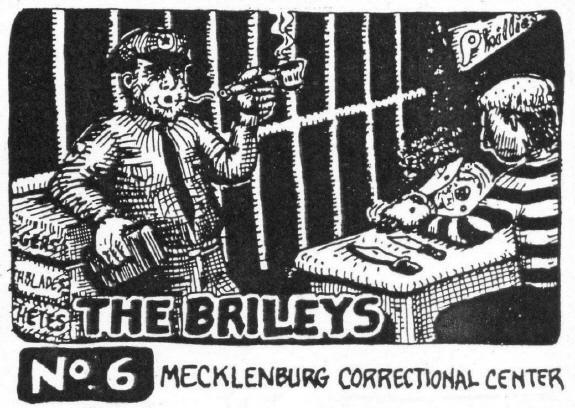
Having terrorized the town with a series of grisly murders five years before, on May 31, 1984, brothers Linwood and James Briley led the largest death-row jailbreak in U.S. history. In all, six condemned men flew the coop by overpowering prison guards, donning the guards’ uniforms and creating a bogus bomb-scare to bamboozle their way out of Virginia’s supposedly escape-proof Mecklenburg Correctional Center.

While their four accomplices were rounded up quickly, the brothers Briley remained at large for 19 days. The FBI captured the duo at a picnic adjacent to the garage where they had found work in Philadelphia.

Linwood was subsequently electrocuted in Richmond on Oct. 12, 1984; likewise, James on Apr. 18, 1985.

While the Brileys were on the run the media coverage, both local and national, was unprecedented. During the manhunt the Brileys-mania led to stories about them being spotted simultaneously in various locations on the East Coast from North Carolina to Canada. When I noticed kids in the Carytown area were pretending to be the Brileys, and playing chasing games accordingly, well, that was just too much.

My sense of it then was the depraved were being transformed into celebrities so newspapers and television stations could sell lots of ads. Once they were on the lam, if it came to making a buck, it didn’t seem to matter anymore what the Brileys had done to be on death row.

“OK,” I said to a Power Corner group in the Texas-Wisconsin Border Cafe on a mid-June evening, “if the Brileys can be made into heroes to sell tires and sofas on TV, how long will it be before they're on collectable cards, like baseball cards? (or words to that effect).” To illustrate my point I grabbed a couple of those Border logo imprinted cardboard coasters from the bar and drew quick examples on the backs, which got laughs.


*
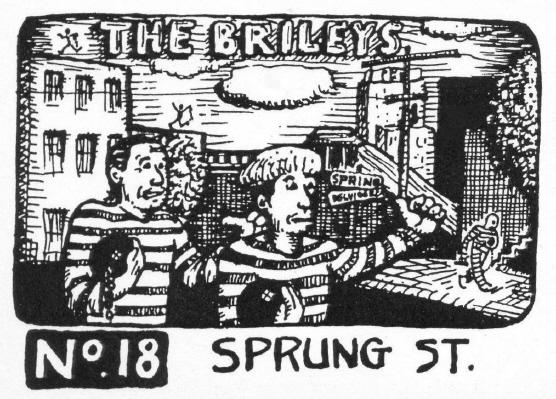
Later at home, I sat down at the drawing table and designed the series of cards. To avoid race humor entirely I used a simple drawing style that assigned no race to the characters. The sense of humor was sardonic and droll. I elected to run off a hundred sets of eight cards each, which were put into small ziplock plastic bags, with a piece of bubble gum included for audacity's sake. I figured to sell them for $1.50 a set and see what would happen.

Traveling about the Fan District on my bicycle it took about three days to sell the first press-run out of my olive drab backpack. New cards were designed, more sets were printed, more plastic bags, more bubble gum. A half-dozen locations began selling “The Brileys” on a consignment basis.

Sales were boosted when the local press began doing stories on them. For about a week I was much-interviewed by local reporters. The Washington Post ran a feature on the phenomenon and orders to buy card sets began coming in the mail from Europe.

Reporters called me for easy quotes to fill articles on death penalty issues; that I was opposed to the death penalty seemed to strike them as odd. Finding myself in a position to goose a story that was lampooning the overkill presentation of the same press corps that was interviewing me was delicious fun. In the midst of a TV news story I announced that T-shirts commemorating the Brileys' 1984 Summer Tour were on the way.

Apart from my efforts, the hated Briley brothers’ chilling crime spree and subsequent escape inspired all sorts of lowbrow jokes and sick songs, and you-name-it, which did indeed fan the flames of racial hate in Virginia.

Naively, I felt no connection to that scene until a stop at the silk screen printer’s plant suddenly cast a new light on the fly-by-night project that summer's effort was. Walking from the offices to the loading dock meant passing through a warehouse full of boxes, stacked to the ceiling. Suddenly, I was surrounded: Four or five young men closed in and cornered me.

Some of them, if not all, had box cutters in their hands; all of them were definitely black. At that moment I felt whiter than Ross Mackenzie. Tension filled the air when their spokesman asked if I was the man behind the cards and T-shirts.

As it was not the first time I’d been subjected to questions about the cards, I quickly asked if any of them had seen the cards, or had they only heard about them. As I suspected, they hadn’t seen them.

Luckily, I had a pack in my shirt pocket, which I took out and handed to the group’s leader. As he studied them, one by one, his cohorts looked over his shoulder. I explained what my original motivation had been in creating the cartoons. No one laughed but the spell was soon broken. I let them keep the cards.
*

Later I was in a drug store, restocking one of my dealers for the cards, when a white lady with blue hair approached me. She worked there and had seen the cards, which she found unfunny. She told me her husband was on the crew that had cleaned up the crime scenes after some of the murders. Then she said if I was going to profit from it, I should be man enough to hear her out.

So, I did. She gave me specific details. It was mostly stuff I had known, or suspected, but the way she told it was brutal.

At this point the success of my absurd art project seemed to be going sour. I got a call from a reporter asking me what I had to say about Linwood Briley having made some disparaging remark about my cards. I got peeved and asked the scribe what the hell anybody ought to care about what such a man has to say.

Like it or not, I had become a part of what I had been mocking in the first place.

Shortly afterward the cards and T-shirts were withdrawn from the market. Unfortunately, without the context of the 1984 news stories being fresh the humor aspect of the cards is somewhat arcane now, because all the images were based on details from those well reported stories.

Three years later I was in the Bamboo Cafe, standing at the bar at Happy Hour, having a beer and talking with friends about sports (probably). A middle-aged man I didn’t know stepped my way to ask furtively if I was the guy who “drew those Briley cards.”

After I said “yes,” and introduced myself, he asked me a few questions about the cards. Then he spoke in a hushed tone, saying something like, “What about those missing cards?”

“Missing cards?” I returned. “Are you asking why I skipped some numbers?

He nodded and reached in his pocket to pull out a full set of The Brileys, still in its original plastic bag.

Wanting to end the conversation quickly -- that he had the cards with him was too strange for me -- I told him the simple truth with no jokes: “OK. First, I wanted to imply there was a vast series out there, without having to create it. Then, I wanted the viewer to maybe imagine for himself what the other cards might be.”

The collector put his cards back in his pocket. He stepped away, plainly disappointed with my easy answer, which gave him no dripping red meat to savor. That night the truth without hype was of little use to my public, such as it was.

-- 30 --

Wednesday, December 26, 2018

Time-Warping

by F.T. Rea

Intro:

In 1955 RKO, which had just changed hands, became the first major Hollywood studio to sell the exhibition rights to its library of feature films to television. Consequently, my early baby boomer generation grew up watching that studio's well-crafted black and white movies on TV. RKO plays a cameo role, of a sort, in “The Rocky Horror Picture Show” (1975).

That particular campy send-up of old science fiction and monster flicks is by far the most significant midnight show attraction of all-time. As such, it needs its own chapter in a proper chronicle of the times at the Biograph Theatre in Richmond, Virginia – a repertory cinema I managed from its opening in early-1972 until mid-1983.

 This photo of Larry Rohr riding up the aisle during a 
midnight screening of the "The Rocky Horror 
Picture Show" was shot on Mar. 1, 1980. 
Photo by Ernire Brooks.
At Midnight Only: 'The Rocky Horror Picture Show' 

"The Rocky Horror Picture Show" was adapted from the British kitsch-celebrating, gender-bending stage musical, “The Rocky Horror Show.” The film version was released by 20th Century Fox in September of 1975.

The play was written in the early-1970s; it opened in London in 1973. Its thin plot cashed in on the time's freedom to pursue pleasure, borrowed somewhat from the hippies' liberating trope – “if it feels good, do it.” Yet, to Fox's distribution bosses, the movie was weird in a way that made it difficult to pigeonhole, marketing-wise. Which couldn't have helped in the promotion for its early first-run engagements.

While “Rocky Horror,” the film, became popular during what might now be seen as the punk era, it wasn't really connected to the aesthetic of punk's defiant nonchalance. Style-wise, its music, written by the play's author, Richard O'Brien, was sort of a bubble-gum knockoff of early rock 'n' roll, fused with a measure of glam rock. Overall, as pop music goes, the songs didn't expand any boundaries. Nonetheless, in the context of the movie the music had it own charm. It was surely no worse than some of the stuff offered in Hollywood musicals of the 1950s.

Anyway, for whatever reasons, in its original release the film was a flop at the box office. It didn't please critics, either. So Fox pulled it from distribution and put “Rocky Horror” on the shelf. No one could have anticipated the one-of-a-kind cult following it would eventually gather as a midnight show.

Note: “The Rocky Horror Picture Show”: 100 minutes. Color. Directed by Jim Sharman (who had also directed the play). Cast: Tim Curry (as Dr. Frank-N-Furter), Susan Sarandon (as Janet), Barry Bostwick (as Brad), Richard O'Brien (as Riff Raff), Patricia Quinn (as Magenta), Nell Campbell (as Columbia), Meat Loaf (as Eddie), Peter Hinwood (as Rocky).

About a year after its original release the second life for “Rocky Horror” is said to have begun at the legendary Waverly Theater (now the IFC Center) in Greenwich Village. At midnight screenings a few audience members began calling out sarcastic comeback lines to the film's action and dialogue.

The funniest remarks were appreciated, imitated, then eventually topped by an attendee at a subsequent screening. Thus, it wasn't originally some adman's brainchild. It just happened.

It should also be noted that midnight shows had been popular in New York City since the late-'60s. As well, they had been running at cinemas in other cities and some college towns for a good four or five years. If a midnight screening went well, at any movie theater, routinely, it might be held over to the next Friday and Saturday. So the midnight show format had already been developed and established when “Rocky Horror” came along.

In the Richmond Biograph's first couple of years of operation midnight show screenings frequently helped keep the lights on. Some of the midnight show features that were popular enough to run for multiple weekends then were: “Performance” (1970); “Reefer Madness” (1936); “Deep Throat” (1972) w/ “The Andalusian Dog” (1929); “Night of the Living Dead” (1968); “El Topo” (1970); “Putney Swope” (1969); “Magical Mystery Tour” (1967). They were promoted using handbills (small posters) and radio spots on WGOE-AM.

During 1977 at the Waverly the role the audience played in the midnight shows enlarged to make the screenings into events with costumes and choreography, as the traditional wall between the screen and the viewers continued dissolving. When the unprecedented interaction between audience and screen jumped from Manhattan to other markets where “Rocky Horror” was playing as a midnight show, such as Austin and Los Angeles, the phenomenon became even more puzzling.

By the winter of 1977/78 “Rocky Horror” was playing to enthusiastic crowds in several cities. Yet, curiously, it had not caught on at others. What would eventually become a popular culture marvel was still flying below the radar for most of America.

As the spring of '78 approached, Alan Rubin, one of my two bosses at the Biograph in Georgetown, asked Fox once again about booking it for Richmond's Biograph. It was already playing at the rival Key Theatre in Georgetown, because Rubin's ex-partner, David Levy, had beaten him to the punch. But Alan was told there still weren't any prints available.

Then, during a trip to Los Angles in May, I heard about the elaborate goings-on at the Tiffany Theatre to do with “Rocky Horror.” Upon my return to Richmond I told Alan and his partner, Lenny Poryles, what I'd learned about its growing popularity in LA. Subsequently, during a conference call with one of the guys at Fox, Alan, Lenny and I were told there was just no enthusiasm at his end for the picture’s prospects in Richmond.

To be fair, in those days Richmond was generally seen by most movie distributors as a weak market – not a place to waste resources. Besides, no one at Fox seemed to understand why the audience participation following for the picture had blossomed in the first place, or more importantly – what was making the movie's cult following catch on in some cities, but not at all in others. So they were holding off on ordering any new prints. Which meant there was no telling how long we might have to wait. It does seem funny now to recall how unconvinced the Fox folks were they had something that was new and old rules didn't apply.

Alan, Lenny and I continued our telephone conversation after the distributor's representative got off the line. That led us to agreeing to a plan: We would offer to front the cost of a new 35mm print, some $5,000, as I remember it, which would stand as an advance against standard film rental fees. There were two provisos: 1. The Biograph would continue hold the exclusive rights to exhibit “Rocky Horror” in the Richmond market as long as we held onto that print. 2. That I would promote it as I saw fit, creating my own materials, rather than rely on Fox's standard press kit stuff (which I was accustomed to doing when situations called for it).

When we called the Fox distributor's office back, it went smoothly. With nothing to lose, they went for the deal. After all, if anything, the Biograph had earned a reputation for being a good venue for midnight shows.

Next, for research, I questioned a couple of publicity people at Fox a little more about how it had been promoted in various situations. Strangely, there was no consensus about what had prompted the successes or failures. However, Fox had encouraged a few exhibitors to call for attendees who would recite certain lines and dance in the aisles, etc. But when they tried to prime the pump in that way it hadn't worked.

After viewing the film, I decided it would be better not to over-promote it. That way there would be less risk of drawing the sort of general audience which might include too many unsatisfied customers – folks who might leave the theater bad-mouthing it. My strategy called for first getting the attention of the kids who had already been seeing “Rocky Horror” screenings at the Waverly or the Key, as well as a few of the most determined of local taste-makers who must see anything edgy first, so they can opine about it.

Accordingly, at WGOE's studio I produced a radio commercial using about 20 seconds of the film's signature song, “Time Warp.” The only ad copy came at the very end with a tag line. The listener heard my voice say, “Get in the act … midnight at the Biograph.”

There was no explanation of what the music was, or what the 30-second spot was even about. At that time the soundtrack for “Rocky Horror” still hadn't become all that well known. The hook was that the spot didn't offer listeners as much information as they expected, which hopefully added somewhat to its underground allure. The same less-is-more approach was used in the print materials.

The Floor Show

“The Rocky Horror Picture Show” opened in Richmond on June 30, 1978. It drew a decent crowd, but it was well short of a sell-out. Some of those who attended did occasionally call out wisecrack lines. Most did not. As I recall, a handful of people dressed up in costumes. As hoped, over the next few weeks a following for “Rocky Horror” steadily grew, as did the audience participation.

At the center of that following was a troupe that became the regulars who turned midnight screenings into performance-art adventures. John Porter, a VCU theater major, emerged as the leader of that group; they called themselves the Floor Show. Outfitted in his Frank-N-Furter get-up, Porter missed few, if any, midnight screenings for the next couple of years.

Plenty of crazy things happened in dealing with the “Rocky Horror” audience twice a week. There was the Saturday night an entire full house was thrown out, because some bare-chested roughnecks had run amuck. They were hosing down the crowd, using our fire extinguishers. Fights were underway. So after a stern warning from me to the crowd, to stop-or-else did no good, I pulled the plug. One by one, they all got their money back.

Interestingly, after that night we never had much trouble with violence to do with “Rocky Horror” again. The Floor Show kids helped to monitor the situation, to make it uncool to go too far. Porter’s leadership was a key to keeping it fun, but not out of control. For his part, John was given a lifetime pass to the Biograph.

There was no stranger episode than the night a man breathed his last, as he sat in the small auditorium (Theatre No. 2) watching “F.I.S.T” (1978). Yes, that lame Sylvester Stallone vehicle was hard to watch, but who knew it could be lethal?

Sitting upright in an aisle seat the dead man’s expressionless face offered no clues to his final thoughts. His eyes were open. He was about 30, which was my age.

The rescue squad guys jerked him out of his seat and threw him onto the floor. As jolts of electricity shot through the dead man’s body, down in Theater No. 1 “Rocky Horror” was on the Biograph’s larger screen delighting the audience. Walking back and forth between the two auditoriums, absorbing the bizarre juxtaposition of those scenes in the same building, was a strange trip, to say the least.

A brief item about the death appeared in the newspaper. It said he had been in bad health. Don't remember his name.

Looking on the bright side, after six-and-a-half years of showing screwball comedies, French New Wave films, rock 'n' roll movies, film noirs, and so forth, the Biograph had earned the chance to have what any theater needs to become fully-fledged – a ghost.

Chasing Dignity

On one of those busy nights early in the run of “Rocky Horror (I can't be sure of the date) a battle broke out in the middle of West Grace Street in front of the theater. Rocks, bottles and whatnot were flying back and forth between two factions of young men. Both squads consisted of four or five participants.

As I later discovered, the fight was between members of a VCU fraternity and an Oregon Hill crew. The most alarming angle of the fraught incident was that it was unfolding a perilous 30 yards from the Cinemascopic, all-glass front of the Biograph. Yikes!

The box office had just closed and the cashier was in the midst of count-up duties. At the same time a small group of friends was in the lobby. Some of them were my Biograph Swordfish softball teammates. A few of us were playing a pinball machine. As the manager of the theater I felt obliged to fend off the danger. Accordingly, I asked the cashier to call the cops and opened one of the twin exit doors, to step onto the sidewalk and yell at the kids.

In so many words I told them to scram. As an incentive I mentioned the cops were already on the way. That was good enough for the frat-boy team. They scampered off.

Meanwhile, rather than pursue their enemies the Oregon Hill gang simply switched over to aiming their missiles at me. A rock hit the curb. A tumbling bottle shattered on the sidewalk, which prompted me to duck back inside.

A second or two later an incoming piece of red brick crashed through the door's lowest glass panel. It struck my right shin. That particular moment of this story stands out sharply in my memory.

There were seven, maybe eight men running in the impromptu posse of employees and pinball players that went after the scattering hooligans. However, my focus was totally on the guy who had plunked me. I chased him as he headed west. Suddenly hemmed in by three of us in a public parking lot at the intersection of Shafer and Grace, he faked one way, then cut to the other.

When his traction gave way in the gravel paving he stumbled to regain his balance. That was when I tackled him by the legs. The others in his group got away.

With some help from my friends – two of them held his arms – we marched the brick-thrower back toward the theater. During that trek I suppose there was some conversation. Don't recall any of what was said, but something the captured culprit said as we passed Grace Place (an excellent vegetarian restaurant) provoked one guy in my group to punch him in the jaw without warning.

One of the policemen in the assembled group of cops in front of the theater sarcastically complimented the puncher for his prisoner-escorting “technique.” Shortly thereafter the punchee was hauled off in the paddy wagon. Back in the lobby I told the puncher he had overreached in hitting the kid unnecessarily, especially while he was helpless.

Caught off-guard by my reaction, my softball teammate laughed. He disagreed, saying essentially that his summary punishment would likely be the only price the guy would ever pay for his assault. Another in the group quickly agreed with him. Others saw it my way, or said nothing.

Then we probably resumed the ongoing pinball game. More importantly, it's quite likely I went across the lobby to the theater's refrigerator in a closet and pulled out enough cans of cold beer to say, “thank you” to each member of the posse.

They had helped protect the Biograph from a menace. And, yes, it was satisfying to have at least caught the one who had just bloodied my shin.

It wasn’t long after that night I found myself poring over a 1931 essay by F. Scott Fitzgerald, “Echoes of the Jazz Age.” Here is the last paragraph of that evocative piece:
“…Now once more the belt is tight and we summon the proper expression of horror as we look back at our wasted youth. Sometimes, though, there is a ghostly rumble among the drums, an asthmatic whisper in the trombones that swings me back into the early twenties when we drank wood alcohol and every day in every way grew better and better, and there was a first abortive shortening of the skirts, and girls all looked alike in sweater dresses, and people you didn’t want to know said ‘Yes, we have no bananas,’ and it seemed only a question of a few years before the older people would step aside and let the world be run by those who saw things as they were — and it all seems rosy and romantic to us who were young then, because we will never feel quite so intensely about our surroundings any more.”
During that reading, seated at my desk in the theater's office, it hit me that the shattering of the Biograph's glass door had been the sound to accompany the hippie era ending. Its trends, causes and distinctive styles had arrived in the late-'60s and they soon would be seen as nostalgia. In some ways the hippie decade had been similar to the Roaring ’20s.

Moreover, the peace-loving, pot-smoking, anti-establishment elements of my generation hadn't changed the world all that much in enduring ways. Ending the Vietnam War and getting rid of Nixon just hadn't solved as many problems as our slogans had promised.

In the summer of '78, it was also time to admit to myself the neighborhood surrounding the Biograph was getting meaner. Which made little sense, even at the time, since it was adjacent to VCU's burgeoning academic campus. Still, for whatever reason the university didn't seem to care then, or for years after this.

A month later, in the General District Court I agreed to a proposal to drop the assault charge, provided the brick-thrower was convicted of a misdemeanor for breaking the glass and that he would reimburse us for the cost of the repairs. A payment schedule was set up.

As we spoke several times after that day in court I came to see the 19-year-old “hooligan” wasn’t really such a bad guy. His payments were made on a timely basis. With his last payment he asked for the name of the man who’d punched him.

While withholding the name, I agreed with him that regardless of my friend's intentions his adrenaline-fueled punch had mostly been a cheap shot. With the money aspect of the debt paid, we shook hands.

Debt and Irony

About a year later, during a Wednesday matinee the Biograph cashier, Gussie Armeniox, was counting a stack of one dollar bills when an opportunistic thief snatched them from her hands. Although I was only a few feet away, behind the candy counter in the lobby, my back was turned. When I looked around, it was alarming to see the robber bolting out the front door. Gussie's wide-eyed, frightened look was unforgettable. It boosted the intensity of the sense of violation.

As I got to the sidewalk the thief was already a half-a-block away. Nonetheless, in spite of his foot speed it turned out he wasn't so good at avoiding capture. Instead of just running to the west, to put plenty of distance between us, he ducked between the buildings, trying to hide. He did it a couple of times, then, when I would find him and get close, he'd take off again.

During the chasing and searching I received some unexpected help from a total stranger. A young man slammed on his brakes and jumped out of his pickup truck. After that reinforcement it took less than five minutes to corner the thief in the men's room of a fast food restaurant. By then a policeman in a cruiser had showed up. Fortunately, that meant I didn't have to go into that men's room to drag the perpetrator out. The cops did it for me.

Of course, I thanked the volunteer and asked him why he’d stopped to help out. He told me he knew I was the Biograph’s manager, because a buddy of his had recently pointed me out to him. His friend?

It was the same Oregon Hill street-fighter I’d tackled a year before. My assistant thief-chaser said his friend told him the story about the broken glass and the assault charge being dropped. Then he said I'd dealt fairly with him. Consequently, a favor was owed to me.

Before he got back in his truck, my collaborator said that in his neighborhood the guys tend to stick together. Thus, he had supported me in my time of need, because of his friend’s debt. I was grateful and flabbergasted.

It now seems to me the sort of obligation he felt and acted upon has been evaporating out of the culture for some time, maybe since the time of this chase scene. The thief turned out to be a repeat offender, so the judge gave him six months for stealing 37 dollar bills.

Looking back on this story what connects those two chase scenes has become increasingly more satisfying. No doubt, that’s partly because in dealing with bad luck and other ordinary tests of character, too many times I’ve done nothing to brag about – even the wrong thing.

Maybe in this two-part adventure I came close to getting it right. In my view, both chases had something to do with pursuing justice and preserving something. Dignity perhaps.

The Exploding Motorcycle

On Friday, March 1, 1980, with its 88th consecutive week, “Rocky Horror” established a new record for longevity in Richmond. It broke the record of 87 weeks, established by “The Sound of Music” (1965), during its first-run engagement at the Willow Lawn Theater.

To celebrate Porter and I dressed in tuxedos to stand before the full house. He held up a “Sound of Music” soundtrack album and I smashed it with a hammer. It went over quite well.

In a nice touch to underline the special night‘s theme, a couple of the regulars came dressed as Julie Andrews. The late Carole Kass, the Richmond Times-Dispatch’s sweetheart of a entertainment writer/movie critic, wrote up a nice feature on what was basically hokum.

That same night Larry Rohr rode his motorcycle through the auditorium’s aisles at the point in the movie when Meat Loaf’s character in the film, Eddie, rides his motorcycle. Rohr’s careful but noisy rides happened only on a few special occasions, such as the record-breaking night. Fortunately, nothing bad ever happened.

A few months later, I had a dream that the motorcycle exploded and blew the roof off of the theater. The nightmare scared me so much the motorcycle rides were discontinued. Anyway, that's what I told people about why we stopped. Yes, now it seems crazy as hell that I ever facilitated such risky shenanigans. Maybe I was somewhat carried away by the aforementioned wide-open permission that went along with the '70s.

With no more motorcycle rides, various Floor Show members sometimes rode a tricycle up and down the aisles. The way members of that group adapted playfully to whatever was said or done in previous weeks was an integral aspect of the fun. They were like players in a story that had new chapters being written for it, on the fly, each weekend.

However, while “Rocky Horror” had an underground cachet in the first year, even the second, eventually its status began to go sour. That was especially so in the eyes of the staff and Biograph regulars who hung out there. The rice, toast and all sorts of other stuff that got tossed around had to be cleaned up each and every time by the grumbling janitors, who naturally grew to detest the movie. To keep the peace they got “Rocky Horror” bonuses — a few extra bucks for their weekend shifts.

Once into the winter of 1980/81 the turnout for the screenings of “Rocky Horror” began a gradual withering. By then many of the originals had stopped coming every weekend. Much of the audience seemed to be made up of sightseers from the suburbs. The fast crowd in the artsy, black leather jacket scene were ignoring it, although the movie was still doing enough business to justify holding onto that original print.

In the summer of 1982 “Rocky Horror” celebrated its fourth anniversary at the Biograph. That same summer, for Program No. 60, I booked a six-week festival offering 12 RKO double features.

The Biograph's record-setting midnight show run of “The Rocky Horror Picture Show” ended on June 25, 1983. Although it had helped pay the rent ($3,000 a month), no one was happier to see that well-used 35mm print shipped out than those of us who had lived warped by the “Rocky Horror” experience for five years.

Outro:

In the Biograph lobby I always got a kick out of listening to enthusiastic new film buffs tell me why the old movie he or she had just watched was cool. Still cool! Of course, in agreeing with them I was just doing my job. Anywhere, any time, stimulating a greater appreciation of good films made in previous times was an important aspect of the manager's duties. I've never gotten over it.

Speaking of time warps, here are the titles for that 1982 RKO fest, listed in the order in which they played: “Top Hat” (1935) and “Damsel in Distress” (1936); “The Hunchback of Notre Dame” (1939) and “The Informer” (1935); “King Kong” (1933) and “Mighty Joe Young” (1949); “Suspicion” (1941) and “They Live By Night” (1948); “Sylvia Scarlett” (1936) and “Mister Blandings Builds His Dream House” (1948); “Murder My Sweet” (1945) and “Macao” (1952); “The Mexican Spitfire” (1939) and “Room Service” (1938); “Journey Into Fear” (1942) and “This Land Is Mine” (1943); “The Thing” (1951) and “Cat People” (1942); “The Boy With Green Hair” (1948) and “Woman on the Beach” (1947); “Citizen Kane” (1941) and “Fort Apache” (1948); “The Curse of the Cat People” (1944) and “The Body Snatcher” (1945).
30 –

Wednesday, June 13, 2018

Flashback: A Beer With the Mayor

Note: It's hard to believe it's been almost 18 years since I wrote "A Beer With The Mayor," about Tim Kaine, for Richmond.com. It was published on Fri., Sept. 29, 2000. At that time I was writing about politics on a regular basis for them.

*
As an observer of matters political, when I learned of Tim Kaine's interest in running for lieutenant governor, it got my attention. Having been favorably impressed with his performance as mayor of Richmond, I was curious about his plans. To get some answers, and to get a feel for Kaine as a player, I asked him to set aside some time to meet with me and spend a few minutes talking politics.

The busy councilman/attorney was kind enough to agree to get together on what is familiar turf for me -- the Baja Bean at Friday happy hour.

Kaine and I sat down at a small table and the waitress took our order; a Rolling Rock for me and a Miller for the mayor. I was glad to see, as a good Democrat, he ordered a beer and not a Slice -- the soft drink he has been seen shilling for in local television commercials.

Once we got past the normal exchange of introductory folderol, I asked him why he wanted to be lieutenant governor. He pointed out that he hadn't officially announced his candidacy, but conceded he was looking hard at running. Then he cut to the chase: He admitted that his long-range sights are on the governor's chair.

He went on to say that for a number of reasons, the lieutenant governor's job seemed like the best move for him to make at this time.

Most of us would probably agree that in politics, little - if anything - is more important than timing.

In July, the sudden withdrawal of state Sen. Emily Couric of Charlottesville - the presumed Democrat nominee for lieutenant governor - threw the door open for Kaine, as well as two others who are reportedly testing the waters: Del. Jerrauld Jones of Norfolk and Del. Alan Diamonstein of Newport News.

Taking On The GOP

Essentially, Kaine indicates he also likes the looks of the part-time position of lieutenant governor because it would allow him to move on - he thinks eight years on City Council will be enough - and up, yet stay in Richmond. He puts value in being able to remain in his Richmond home, to spend time with his wife and three children, ages 5 through 10.

As far as his agenda is concerned, Kaine points to education as his chief interest and what would surely be at the center of any campaign of his for statewide office.

"Virginia is deeply underfunded in education, K through 12," says the mayor with the assurance of a man who can back up what he just said.

He explained that Virginia's Republicans - in order to strike the populist pose of tax-cutters - have shifted a greater portion of the burden of the cost for public education to the localities. They did this by cutting local taxes, such as the car tax, rather than income taxes. So while we are in a time of general prosperity, the cities and counties are hurting for revenue even as the Commonwealth remains flush.

Beyond education, Kaine is already on record as a supporter of tougher controls on access to handguns and other common-sense measures to restrict exotic weapons. As well, he intends to run against the death penalty. In his view, taking what I'd call a progressive stand on these issues will play better across the state than some would argue.

His Republican opponent, should Kaine secure his party's nomination, will likely characterize those positions as liberal. But Kaine doesn't flinch at the prospect. It is his reading that such positions on guns and the death penalty are consistent with mainstream thinking in Virginia today.

Running On Beliefs

Cheerfully, he told me it's his intention to run on what he believes. He hopes to win. If he loses, he'll be happy to go on to live the good life of a successful attorney and family man. I gathered that he wants to be governor one day, but he doesn't need to be governor at all costs.

"I like public service. And I think I'm good at it," Kaine says.

When time permits, he plans to stump for Chuck Robb. He'll put off any official announcement concerning his own running for office until after November's general election.

I do have one bit of free advice for Richmond's savvy and genial mayor: He should make that silly Slice commercial the last of its ilk. Although it may have seemed harmless when the prospect was pitched to him, as it appears on TV, the gesture comes off as bush league (not a whit of reference to anybody named Bush is intended), even if it's not inappropriate.

Maybe an eager police chief, even a small-market mayor, does it for a laugh. But in my view, it's not the sort of thing a Virginia governor does.

Or, maybe I'm being a stick in the mud.

Nonetheless, I suspect Tim Kaine has a bright future in politics. His grasp of the circumstances in which he is operating sounds sure. His natural confidence in his own view of the political landscape strikes me as refreshing. He comes off as a man who does his own thinking, and his sense of purpose seems genuine.

If Tim does get as far as the governor's mansion, I hope he'll still find the time to have a cold beer and talk politics at happy hour.

-- 30 --
-- My illustration (2004). 

Tuesday, June 12, 2018

Chuck Wrenn: Rock 'n' Roll Impresario

FiftyPlus, October 2002
By F.T. Rea

 Note: This magazine feature was written 16 years ago by yours truly.

Detail from a postcard-style invitation to Chuck Wrenn’s
40th birthday party on the James River. My art (1985). 

Twenty-two years ago, when it was generally accepted that large-scale outdoor rock ‘n’ roll events couldn’t be staged in Richmond, Chuck Wrenn put three fully-amplified bands, including the impeccably authentic Memphis Rockabilly Band, on a flatbed trailer in the cobblestone alley behind his back yard. It was the fourth edition of High on the Hog, Church Hill’s live music and pork-worshiping festival.

The 1980 event featured a serendipitous, career-defining moment for Wrenn. It began raining. Rather than lose momentum by shutting off the electricity and waiting out the downpour, host/emcee Wrenn broke out rolls of heavy-gauge transparent plastic. Soon, with the help of many happy hands, he had improvised a canopy to protect the stage and cover part of the yard. In effect, he wrapped the whole shebang.

Yes, the show went on. With electric guitars wailing in defiance of the chilly rainstorm, the sense of common purpose felt by one and all was remarkable. And, Richmond’s best-known bartender and most indomitable impresario was emerging as the arbiter of what was valid to a generation of Richmond’s musicians and nightlife aficionados. 
  
To this day, when it comes to rock ‘n’ roll, Chuck Wrenn remains Richmond’s kahuna.

*

Charles E. “Chuck” Wrenn began his love affair with show business in 1964 at the Cary Street Coffeehouse, with its open microphone for folksingers and the like. Then a senior at Hermitage High School, Chuck eventually slid into playing with an amalgam of enthusiasts known as the North Pine Street Jug Band.

Pat Jagoda, organizer of a couple of reunions of the coffee-house gang, was also in high school (Douglas Freeman) when she discovered the small folkie scene emerging in what is now Carytown. Today, Jagoda books talent for the Virginia Museum of Fine Arts' fabulously successful live music series called Jumpin’, a concept that Chuck helped set in motion in the ‘80s by booking the bands for its first three years.

“Chuck has remained true to those very first experiences and brought an amazing group of people into the musical circle for audiences to experience,” Jagoda says. “What has become even stronger since those early years is his passion for music.”

Next, as a fine-art student at Richmond Professional Institute (RPI was the predecessor to Virginia Commonwealth University), Chuck became fascinated with the shifting breeze of popular culture coming from San Francisco, particularly the seminal psychedelic shows at the Fillmore Auditorium. On August 4, 1967, to present their own version of a Happening with music and lights, he and two friends rented Tantilla Gardens on West Broad Street.

The band, put together for the occasion by Ron Courtney, was called Actual Mushroom. The light show was essentially Chuck and fellow art student Eric Bowman using an overhead projector with various props. Chuck’s underground-comix-style art on the handbill touted the promised spectacle as the “first psychedelic dance in Virginia.”

“We sold out, but we lost money,” recalls Chuck. “Yep, been losing money ever since.”

Chuck worked construction jobs and served 3.2 beer in student dives on Grace Street to make money during college. Then, in a Fan District garage, he started a business assembling custom-made stretched canvases called the Square Deal Stretcher Shop.

*

After VCU, Chuck and his wife, Myra, lived on Cape Cod for about a year. He took work as a maintenance man at a seaside national park while she learned to be a bartender, a trade difficult to pick up in Richmond. The concept of serving cocktails, or what had been coined “liquor by the drink,” was still new to Virginia. People had been accustomed to doing their away-from-home drinking in exclusive clubs, neighborhood beer joints, and shot houses (unlicensed bars on the wrong side of the tracks).

When he re-turned to Richmond in 1972, Chuck signed on to become one of the original staff members of the Biograph Theatre, located a block from the VCU campus. Having been chairman of the student film society at VCU, the role of assistant manger at the town’s new repertory cinema fit like a glove. Chuck’s promotional savvy contributed much to the establishment of the midnight show as a staple for the plucky Biograph over its 15-year run (1972-87).

Myra took a bartending job at Poor Richard’s, the city’s first downtown watering hole that had a Georgetown air about it. In the fall of 1973 Wrenn left the movie business to become his wife’s trainee, hoping to learn what he saw as a useful skill in changing times.

Today, Chuck’s first wife and bartending instructor, Myra Daleng, is director of dance in the University of Richmond's Department of Theatre and Dance.

A year later Chuck became head bartender at J. W. Rayle, where he eventually began booking local rock ‘n’ roll bands, hoping to attract customers. It worked. Wood-paneled, with lots of stained glass, Rayle (located at Pine and Cary Streets, on the site of what is now a VCU dormitory), was a huge hit. But it came and went like a comet (1974-77).

In 1978 Chuck began renovating a 100-year-old house on East Franklin Street, which connected him to a new part of town and a lively set of baby-boomer neighbors, who the year before had staged a small neighborhood party they dubbed High on the Hog. Chuck’s band, Faded Rose, graced the second edition, also attended by a small contingent of neighbors and friends.

Chuck’s self-styled role with High on the Hog -- booking bands, serving as emcee, and fronting his own group (later the Megatonz) -- was essential to building what became a mammoth annual party. Anticipating the seventh edition of High on the Hog in 1983, it became clear to its planners that the party had outgrown its location in the alley. But the event had become so popular that it was time to go legit. So with the City’s blessing, it moved across the street to Libby Hill Park.

After nearly a decade of frowning on mixing amplified rock ‘n’ roll with fresh air and beer, Richmond’s official stance had changed. Thus the door was opened for Jumpin‘, Friday Cheers, and the other mainstream music events that are now commonplace in Richmond.

Among the many acts to have appeared on High on the Hog’s stage in the public park, three notables are Billy Price and the Keystone Rhythm Band (1983 and ‘85), NRBQ (1987), and Marcia Ball (2001). On October 12, 2002, High on the Hog No. 26 will feature Julie Johnson and NRG Krysis, plus others. Admission, as always, is free.

*

In 1982 Chuck began a 14-year partnership with friend Barry Gottlieb. In character as Rockin' Daddy (Wrenn) and Mad Dog (Gottlieb), they wisecracked and gave out the scoop on entertainment essentials to 2,500 callers per week, via recordings on a bank of telephone answering machines. The enterprise was known as the Rockline.

“We normally did it [the three-times-a-week tapings] in the morning,” says Gottlieb, now a San Francisco-based writer. “Remember, he usually closed whatever bar he was working at, so he came in after only a few hours sleep. We were efficient, goofy, had fun, rarely if ever did a retake.”

In the mid-‘80s Chuck began putting shows together (in various locations) for Duck Baker, a chum from his Cary Street Coffeehouse days and today a world-class jazz guitarist. Because Baker (still not a rich celebrity) was living in San Francisco or various parts of Europe, those gigs helped to pay for his trips home.

Similarly, while working at Bird in Hand, a Shockoe Bottom restaurant/club in the late-‘80s, Chuck began presenting reunion shows of the Good Humor Band near Christmastime. During the late-‘70s and early-‘80s, that Richmond-based group was one of the most popular touring rock bands on the East Coast. In 1983 they disbanded, and most of the musicians relocated to Nashville.

“I moved from Richmond nearly twenty years ago,” says Mike McAdam, the band’s lead guitarist and founder. “Whenever I visit, I always see my Mom, and I always go have a beer with Wrenn. It confirms the fact that Richmond is still my home. Come to think of it, my Mom and Chuck are nearly the same age. Jeez, I hope they didn’t date in high school, or anything.”

*

In 1992 Chuck became a partner in a new Shockoe Bottom venture called the Moondance Saloon. Due to the stresses of the nightclub business, the original partnership soon fell apart. He took a beating, money-wise, but new partners appeared, Chuck shrugged off his losses, and the show went on.

Manny Mendez, one of the new partners, ran the Moondance kitchen until he left to open his own restaurant, Kuba Kuba, located in the Fan District. Of working next to Chuck for years, Mendez says, “He made it fun! You’re having more fun than the people you’re serving. He never has anything mean to say.”

However, even Chuck’s determination and expertise couldn’t reverse a trend that had the Bottom evolving into a loud, randy, and youth-oriented milieu that intimidated many of the graying music lovers who had made up a significant part of his crowd.

On top of that, the two-headed monster of red tape, the City’s and the Commonwealth’s (ABC Board), persistently hobbled his gritty efforts to keep what was the favorite stage of area musicians from going dark. When the Moondance closed in 1999, Chuck was lucky to get out with his shirt.

Fortunately, at the same time Michael Britt, owner of Poe’s Pub, was looking for a bartender with a following. Since then Chuck has worked at Poe's, located at the foot of Libby Hill Park, doing basically the same thing he’s done for more than twenty-five years: pouring drinks and booking bands. Now he can walk home from work.

Ever the optimist, Chuck took his third trip down the aisle on April 1, 2002. And, for the first time he has become a father. Chuck's wife, Hollie, gave birth to their daughter, Eliza Marie Wrenn, on May 9.

“Chuck has taken like a duck to water to fatherhood” says Hollie, who received an art history degree from VCU in 1995. “He keeps her when I need a break, or go to work. He probably changes more diapers than I do.”

Hollie worked as a waitress at the Moondance and upon Mendez’s departure ran the kitchen. She says Eliza has already been to several live music shows. “Eliza, like most babies, I think, loves music,” says Hollie. “She listens to everything I do, from the Ramones to Mozart. She gets very excited and kicks her legs and moves herself all around.”

Chuck’s reaction to midlife fatherhood? He answers, perceptively: “Rather than changing my life, it’s been a wonderful addition.”

*

How does a silver-haired, bushy-eyebrowed 57-year-old who got his show biz start in a jug band keep up with the latest? Must he follow Britney Spears’ latest warblings, or which titles are climbing the hip-hop charts?

No, he doesn’t. “I book and promote what I understand, what I like,” he says with a smile. And so it continues. The region’s veteran musicians, whether they play rhythm and blues, bluegrass, or an esoteric genre of rock ‘n’ roll, can hardly remember a time when they didn’t rely on gigs that Chuck provided, in one way or another. Craig Evans and Billy Ray Hatley are two of them.

“I don’t know a musician around who has a bad word about him,” says Evans, who plays with The Taters, “which is quite a testimonial for someone in his position.”

“Without Chuck there are a lot of people and bands that would not have gotten their first gig,” adds Hatley, of Billy Ray Hatley & the Showdogs.

Mike McAdam, who has recorded and toured with a number of nationally renown acts says, “He has single-handedly kept true rock ‘n’ roll alive in Richmond.”

When Chuck started putting bands on stage at J. W. Rayles in the mid-'70s, there was no rock ‘n’ roll scene in Richmond, only garage bands playing at private parties. Good musicians left town. In the years since, no one has done more to change that than Chuck Wrenn.

But for his efforts, it’s unlikely he’ll ever get the key to the city.

Chuck shrugs off his triumphs and defeats by snapping off a telling quip about his near legendary career managing Richmond’s night life: “Every night was Saturday night, every morning was Monday.”