Wednesday, August 21, 2013

Unvarnishing Virginia History


Note: The piece below was originally published by STYLE Weekly in 2007. The recent chatter about a giant Confederate flag waving over a highway into Richmond made me want to post it here. A few years ago, a retired educator gave me the history book mentioned in the piece. I hope he enjoys seeing what his gift inspired.

*

Having grown up in Richmond, I've been steeped in its dual sense of bitterness and pride over matters to do with, and stemming from, the Civil War. Perhaps thinned out somewhat by time, it remains in the air we breathe at the fall line of the James River.

Most of my life has been spent in the Fan District, which is home to four statues honoring heroes of the Confederacy. Beyond monuments, to know what it was like in Richmond in the past, we look to history. It comes to us in many ways — stories told, popular culture and schooling among them.

In 1961, my seventh-grade history book, which was the official history of Virginia for use in all public junior high schools — as decreed by the General Assembly — had this to say about slavery at the end of its Chapter 29:
Life among the Negroes of Virginia in slavery times was generally happy. The Negroes went about in a cheerful manner making a living for themselves and for those whom they worked. They were not so unhappy as some Northerners thought they were, nor were they so happy as some Southerners claimed. The Negroes had their problems and their troubles. But they were not worried by the furious arguments going on between Northerners and Southerners over what should be done with them. In fact, they paid little attention to those arguments.
In 1961 I had no reason to question that paragraph's veracity. Baseball was my No. 1 concern in those days. Now those words read quite differently.

Living through the struggles of the Civil Rights era, with its bombings, assassinations, marches, sit-ins, boycotts and school-closings, did much to show me a new light, to do with truth and fairness. However, for me, there was no moment of epiphany, no sudden awareness I was growing up in a part of the world that officially denied aspects of its past. More than anything else, it took time. Life experience taught me to look more deeply into things.

Now I know that dusty old history book was a cog in the machinery that made the Jim Crow era possible.

Nonetheless, that same history book's view of how it was for those enslaved is one that some Virginians still want to believe. It's probably what they were taught as children, too. Some call it "heritage." Many of this persuasion also cling to the bogus factoid that since most Southerners didn't hold slaves, the Civil War itself was not fought over slavery.

Which is preposterous.

Of course poor Southerners, those who weren't plantation owners, had little to do with starting the Civil War. Generally speaking, poor people with no clout don't launch wars anywhere; rich people with too much power do.

So, for the most part, the men who fought in gray uniforms were doing what they felt was expected of them. As with most wars, the bulk of those who fought and died for either side between 1861 and 1865 were just ordinary Joes who had no say-so over declaring war or negotiating peace.

In Virginia, many who chose to wear gray did so to reverse what seemed to them to be an invasion of their home state. That's the reason the heritage clingers like the best.

Yet, if the reader wants to understand more deeply why Virginia eventually left the Union, to follow the secessionist hotheads of South Carolina and Mississippi into war, here's a clue from Chapter 30 of that same history book, which opened with this:
In 1790 there were more than 290,000 slaves in Virginia. This number was larger than that of any other state.
Those 290,000 slaves were worth a lot of money to their owners and such wealthy families had a lot of say-so.

Thus, the largest part of the real blame for the bloodshed of the war, and the subsequent indignities of the Reconstruction era, probably rests with wealthy slaveholders who would not give up their investments in cheap labor without a fight.

Readers interested in how much the official record of the Civil War has changed over the decades since the Civil Rights era should pay a visit to the Virginia Historical Society in Richmond. Its telling of the story of the Civil War is now based on the unvarnished truth.

Moreover, I am proud to be a Virginian. There's plenty of Virginia history that has nothing to do with picking sides in the Civil War. My ancestors go back to the 1600s in this commonwealth. But I will not stand with anyone who chooses to stay the course with the absurd denials of history — to do with slavery — that were crammed into that old public school textbook.

As for my friends in Richmond who haven't had a fresh thought on matters racial since they were seventh-graders, well, I don't want to pick a fight with them. So mostly we talk about other things — baseball still works.

All that said, Robert E. Lee, whose spectacular monument I see every day, remains a Virginian I admire. I realize his reputation has taken somewhat of a beating in recent years, but the dual sense of tragedy and dignity his statue conveys remains striking. In his time and place, torn between loyalties, it seems to me Lee tried to do what he saw as his duty.

After the war a weary Lee urged his fellow Virginians to let it go — to move on. That was good advice in 1865. It still is.

-- 30 --

Note: The illustration was fashioned after Jean Antoine Mercie's Lee Monument (unveiled in 1890). "Mercie's Lee," by yours truly, was done in ink and pastels.

Friday, August 9, 2013

Nixon's Fall


Note: This is a rewrite of a piece I penned for Richmond.com in 1999. I did the illustration, too, it accompanied the article.

*
August is usually a slow month for news, so we are spoon-fed anniversaries to contemplate: Hiroshima’s 68th, Woodstock’s 44th and 39 years ago Pres. Richard M. Nixon took the fall -- he resigned. Nixon quit the job, waved goodbye and left town.

The entire culture shifted gears the day President Nixon threw in the towel. The brilliant strategist, the awkward sleuth, the proud father, and the coldest of warriors had left the building.
August 9, 1974 was a day to hoist one for his enemies, many of whom must have enjoyed his twisting in the wind of Watergate’s storm. It was the saddest of days for his staunch supporters, whose numbers were legion.

Either way, Richard Nixon’s departure from DeeCee left a void that no personality has since filled.

For the first time since his earliest commie-baiting days, in the late-‘40s, Dick Nixon didn’t matter. With Nixon gone being anti-establishment promptly went out of style, too. With the war in Vietnam no longer a front burner issue, "streaking" -- running around outside naked -- replaced the anti-war rally as the most popular gesture of defiance on college campuses.
Soon what remained of the causes and accouterments of the ‘60s was packed into cardboard boxes to be tossed out, or stored in basements. Watergate revelations killed off the Nixon administration’s chance of instituting national health insurance. Many people have forgotten that his regime was also easily more liberal on racial and environmental matters than any before it.

Although he was a hawk, Nixon was moderate on some of the social issues. His opening to China and efforts toward détente with the Soviets are often cited as evidence of Nixon's ability to maneuver deftly in the realm of foreign affairs. No doubt, that was his main focus. But at the bottom line, Nixon is remembered chiefly as the President who was driven from office. And for good reason.

Nixon’s nefarious strategy for securing power divided this country like nothing since the Civil War. Due to his fear of hippies and left-wing campus movements, Nixon came between fathers and sons. To rally support for his prosecution of the Vietnam War he demagogued and exploited the bitter division between World War II era parents and their baby boomer offspring in such a way that many families have never recovered.

However, Nixon’s true legacy is that since his paranoia-driven scandal, the best young people have no longer felt drawn into public service. Since Nixon's resignation -- taken as a whole -- the citizens who’ve gravitated toward politics for a career have not had the intellect, the sense of purpose, or the strength of character of their predecessors. I can't prove that but it is my sense of the truth.

Some trace the cycle of endless paybacks across the aisle to that era, as well. We can thank Tricky Dick for all that and more.

So weep not for the sad, crazy Nixon of August, 1974. He did far more harm to America than whatever good he intended. On top of that, he had twenty years to come clean and clear the air. But he didn’t do it. He didn't even come close. In the two decades of his so-called “rehabilitation,” before his death in 1994, Nixon just kept on being Nixon.

Some commentators have suggested that he changed over that period, even mellowed. Don't buy it. The rest of us changed a lot more than he did. While I acknowledge his guile and I'm still astounded at his monumental gall, President Nixon was a man who choked on his own bile.

So, spare me the soft-focus view of the Nixon years.

Yes, dear reader, I’m here to remind you that Tricky Dick Nixon's fall from grace should be a lesson to us all -- he got what he deserved.

-- 30 --

Sunday, July 21, 2013

That's a Lot of Turkey

If you can pull yourself away from reading about the Zimmerman trial aftermath and the Uncle Jonnie’s Rolex scandal, I’ve got a story about the Virginia gubernatorial race. There was a 90-minute debate between the two major party hopefuls, Ken Cuccinelli and Terry McAuliffe, on Saturday morning and something telling happened.

It was something that was rather surprising to me.

Yes, it’s still mid-July -- perhaps the peak of the silly season for politics -- but what happened on the tony Homestead's debate stage in Hot Springs may play out to make a difference in the outcome of the race. But first, here’s what happened at the debate before the Virginia Bar Association audience, if you only focus on what was said.

Essentially, both candidates stuck to their scripts, so there weren‘t many surprises in the content of what they said. No, the surprise for me was all in how they said it; the difference in the body language and demeanor of the two candidates was striking.

As far as what was said, here it is in a nutshell: The Republican candidate, Virginia Attorney General Ken Cuccinelli, repeatedly said that his Democratic opponent, Terry McAuliffe, is a Washington insider (read that as saying he's not a true Virginian). McAuliffe, the former chairman of the Democratic National Committee, repeatedly cast Cuccinelli as an ideologue who is backward on social issues (read that as saying he will keep new businesses from locating in Virginia).

In the first half of the Judy Woodruff-moderated debate Cuccinelli seemed in over his head. He appeared to be scared and unsure of himself. At the same time, McAuliffe hit the ground running, brimming over with confidence. He was well prepared and it showed.

Among the topics covered were:
  • Teachers’ pay.
  • A $1.4 billion tax cut proposed by Cuccinelli, about which he refuses to divulge any specifics.
  • Same-sex marriage
  • Abortion
  • McAuliffe’s car company failings
  • Transportation in Virginia
  • Gifts from Star Scientific
  • Should Gov. Bob McDonnell resign?
  • Health care/Obamacare
  • The Sequester’s impact on Virginia
  • Immigration Reform
Cuccinelli scored best on Obamacare and the Sequester. McAuliffe scored best on the social issues and transportation.

When Cuccinelli did manage to recover somewhat from his shaky start, in the debate’s last half-hour, he tried to affect his cock-of-the walk style. However, it seemed a little forced and he still looked self-conscious. Which all seemed to underline the notion that Cuccinelli’s style works much better when he’s working a highly partisan crowd, or being interviewed by sympathetic questioners.

McAuliffe chided Cuccinelli for accepting a trip to New York, paid for by Jonnie Williams, when the attorney general’s office was dragging its heels on a tax dispute between one of Williams' companies and the commonwealth. Cuccinelli said he was merely standing in for Gov. McDonnell, at the governor‘s request.

McAuliffe mentioned a $1,500 turkey dinner the AG presumably enjoyed, for which Williams picked up the check. Then the Democratic candidate chuckled, “That’s a lot of turkey!”  

Yes, it was surprising to me how much better McAuliffe performed in this first debate. He seemed likeable and quick on his feet. Up until today, I had been more than a little worried than Cuccinelli would be the more confident debater. Now I wonder if Cuccinelli ought to just avoid any future one-on-one debates.

McAuliffe's biggest stumble was caught by PolitiFact. McAuliffe said a report on connections between Uncle Jonnie and Cuccinelli, issued by Richmond Commonwealth’s Attorney Michael Herring, said Cuccinelli should have been prosecuted. It did not.

Of course one debate shown on PBS in July won’t settle the contest. But with McAuliffe slightly ahead in the early polls and his strong performance on Saturday, momentum is now clearly on his side.

For his part, Cuccinelli tried to distance himself from McDonnell’s snowballing Uncle Jonnie problem, but it wasn’t convincing. When questioned about abortion Cuccinelli mostly ducked the opportunity to double-down on his anti-choice, anti-contraception positions of the past.

So, here’s why this first debate matters -- of course, it’s the money. Cuccinelli is probably going to have more trouble raising money now. Some of the GOP’s fat cats may already smell a loser. Smart Republicans may son decide to invest their time and money into holding onto the AG’s job and maintaining control of the House of Delegates.

So, even though this is just July, Cuccinelli may already be in trouble. If he can’t raise enough money to saturate Virginia with commercials in the fall, AND he can’t best McAuliffe in debates, he’s probably going to lose in November by double digits. Like McDonnell is expected to do, he could end up hurting other Republicans in their own races.

For the first time this year, I see McAuliffe’s chances to overcome Cuccinelli’s advantage of his well-cultivated right-wing media darling image as being pretty good.

All in all, July 20, 2013, was a good day for Virginia Democrats -- especially for the most relentless of the Cooch Watch activists.

*

Update: To watch a recording of the debate click here.

Tuesday, July 2, 2013

Who's Afraid of the Big Bad Referendum Wolf?


In 2009, in doing research to write about the baseball stadium controversy, I discovered that in 2005 Richmond’s city council had opted to hold a referendum about the location of a new baseball stadium. Then, for some reason(s), the same group of people subsequently decided to forget about that method of finding out what the voters wanted.

Looking back on all the squabbling since 2005, plus losing the R-Braves in 2008, and so forth, and I have to think that if an advisory referendum had actually been held eight years ago, we would probably be in a different place today. That was a lost opportunity.

After 10 years of City Hall getting nothing done, in 2013, the elected officials opposing the referendum must have their reasons, too. However, unlike 2005, this time they should be pressed to reveal them. And, if those reasons sound flimsy, it should be noted.

Click here to read my OpEd, “Let the people speak about where to play ball,” which appeared in Sunday’s RT-D.

Contrary to the politicians and activists who oppose the referendum now, I am not afraid of allowing for a clear expression of the will of the people. And, I believe that if Richmond’s voters are allowed to vote on whether they want to move baseball away from the Boulevard, they will overwhelmingly say "no."

Without a referendum in November, my fear is that we will see another steamroller -- reminiscent to how the Redskins deal was pushed through -- come chugging out of the mayor‘s office. My sense of one reason why Second District Councilman Charles Samuels has proposed a referendum is that he wants to avoid a repeat of that way of doing things in Richmond.

Furthermore, my guess at what will happen if the voters do emphatically say NO to baseball in the Bottom is that it will finally kill the notion -- wooden stake in the heart. I don’t believe many politicians in town have the foolish nerve to ignore such a obvious sign of what the people want. So, objecting to the referendum process by saying it’s non-binding, and therefore a waste of time, is a red herring.

Saying referendums are not part of good governance, because elected representatives should make such calls -- egad! we don’t want to be like California -- is just as much a red herring.

Unfortunately, there are some politicians and activists in Richmond who don’t want to see Charles Samuels be successful with this, because they don’t want him to get a feather in his cap. And, there are some who are just waiting for Mayor Dwight Jones to announce a plan to build a stadium in the Bottom, so they can further their own agendas by calling press conferences to oppose the plan. They are playing a dangerous and self-serving game.

There are also local strategists who are worried about what effect putting a referendum on the ballot might have on the chances some candidates have of getting elected. So, they are happy to join the red herring brigade, too.

Last night’s committee meeting and vote, 6-3 against allowing a referendum, was a preliminary exercise. There’s still time to let your representative on Council know how you feel. The vote that will actually matter is scheduled for next Monday, July 8 (6 p.m. -- 7:30 p.m).

Members of Council are politicians. If they see a huge turnout in favor of a referendum a couple of them will probably be smart enough recognize they need to rethink the matter, pronto. After all, what will it really cost them? Only two members of Council need to change their minds. 

After celebrating your independence on July 4th, demand direct democracy on the 8th! Go to City Hall on Monday to support the cause.
  • Richmonders who simply don’t want a baseball stadium built in Shockoe Bottom should want a referendum.
  • Richmonders who think refurbishing the Diamond is best, rather than borrowing huge millions to build a new stadium from scratch, should want a referendum. 
  • Richmonders who want any new baseball stadium to eventually be built on North Boulevard, regardless of how it is financed, should want a referendum.
  • Richmonders who can't stand sports and don’t want to see the city spend a nickel on a baseball stadium anywhere in town, should want a referendum. 
  • Richmonders who just want the matter settled, after 10 years of uncertainty -- one way or the other! -- ought to see that a referendum is the best way to get it over with.
If City Council votes the referendum proposal down at its next meeting, it will be ignoring a lot of people. And, for sure, some of those folks aren't going to forget who denied them their chance to finally have some say-so in this matter.

*

Click here to see the Facebook group page that is gathering the people who are calling for City Council to allow a referendum to be on the ballot. Join up, if you like. The name of the group is Referendum? Bring It On!

The group's statement of purpose is as follows: 
While our reasons vary, the members of this Facebook group stand united in our opposition to building a baseball stadium in Shockoe Bottom. After 10 years of studies, campaigns and debates concerning such a project, we now call upon Richmond’s City Council to allow the city’s voters to weigh in on the discussion by way of an advisory referendum on November 5, 2013. We are not afraid of democracy.  

Monday, March 25, 2013

Dr. Franken-Smart's Monster

https://blogger.googleusercontent.com/img/b/R29vZ2xl/AVvXsEhP8fUDw7LPCFVVXcvgoNis0KI5BSRB7eyAh7S711u00ApT0DpHhaPgxNs3mpE_6wT6sgoI-yHPFapm6cgOvg0ZLDTEL1vFXKqgTDkxXr2LQh1rHdA8US1dKrB9wp3oxIbBThHr7p25WWh9/s320/Smart_3by3.jpg

Along with the buzzer-beaters and blowouts of March Madness come the firings in the coaching ranks. Along with the head coaches of losing teams getting fired, some coaches whose teams made the 68-team field of the NCAA tournament get axed, too.

Accordingly, UCLA has fired Ben Howland and Tubby Smith is out at Minnesota.

Howland, 55, was 233-107 in 10 years at UCLA. This year his team won the Pacific 12 regular season title and went 25-10. Ironically, his Bruins lost to Smith’s Golden Gophers in the NCAA tournament. Smith, 61, was an overall 124-81 in six seasons at Minnesota. He went 21-13 this year. Minnesota just lost to Florida in the round of 32.

UCLA and Minnesota qualifying for the NCAA's championship tournament wasn't enough. Headlines (here, here) are linking those two openings to Virginia Commonwealth University’s Shaka Smart (pictured above).

Which means, with the Sweet 16 games still to be played, the annual Shaka Watch has already started. In four years at VCU Smart, 35, has an overall record of 111-37. During the 2012-13 season Smart became the second youngest coach to win 100 games.

Last year Smart turned down an offer to make $2.5 million a year coaching at the University of Illinois. Why did he turn down roughly a million dollars more than he makes at VCU?

Perhaps Coach Smart had a list of good reasons to stay. Maybe he likes his job. Maybe he likes Richmond; he and his family have bought a home in the Fan District. Maybe he’s not chasing money, so much as it is chasing him. And, it could be that VCU’s phenom of a basketball coach is still in the process of building a project -- a basketball monster.

VCU's monster-in-progress looks like it's being built to consistently compete for the national championship. And, before Dr. Franken-Smart leaves his West Broad Street laboratory, this intense mad scientist wants to see his brainchild strut its monster stuff in the last tilt of the NCAA’s Big Dance.

When Smart first came to VCU, right away, he talked about his new system. He called it “Havoc.” Later, after one of his first games, in the media room in the Siegel Center Smart explained how it would work. He said no one would likely be playing 38 minutes a game, because to go at the pace he wanted, no player -- no matter how well conditioned -- would have the stamina. He said he would use his bench more liberally than many coaches do, because starters would play fewer minutes. 

The problem in the beginning was that he was using the previous coach’s recruits. Not to say they were bad players. Not at all. But to make Havoc work as he envisioned, Smart needed better defensive players than Joey Rodriguez, like maybe a Briante Weber. He also needed big men who could run the floor better than Jamie Skeen, like maybe a Juvonte Reddic. And, yes, he needed slashers to the basket with more finishing ability than Brad Burgess ... like Treveon Graham, for instance.

All three of the former Rams stars mentioned above were good basketball players -- guys who gave their all to the program and brought glory to it. While Smart coached them quite effectively, they weren’t handpicked by him to execute his trapping, overplaying defensive scheme.

Smart’s game plan also calls for open-court, unselfish play on offense -- a total commitment to group thinking. Truth be told, it’s harder to find the sort of player who is capable of thinking that way on most of the rosters of successful schools in the top six conferences. Weber, Reddic and Graham will all be back next year and Smart’s recruiting class for 2013-14 is fast afoot and impressive.

The pampered stars at Kentucky and Kansas don’t want to have to practice or play the smothering defense Smart insists upon. Nor do they hope/expect to play four years of college basketball.

Whereas, at VCU, the players are onboard for four years and they graduate. If Smart were to take his demanding system to a major conference school, it might be harder to sell it to talented one-and-done kids on their way to pro basketball. What Smart now has at VCU is a group of bright kids, who want to prove they can consistently beat such teams with a well-executed plan and an all-out effort.

With Dr. Franken-Smart as their coach the Rams seem to believe they can do it. After all, most of their opponents have no way of practicing realistically to face the monster known as Havoc.

Last year Smart’s players had to have loved it when he walked away from the temptation of more money. Coach is all in, too, is what they must have taken away from Smart’s continued dedication to building a program at VCU. If he does it again this time that feeling will only expand.

Yes, it’s reasonable to assume Smart will one day leave VCU to coach elsewhere. Someday an irresistible offer will come. Still, Rams fans hope the good doctor will wait for a call from an athletic director at a major program who wants to replace a longtime successful coach, a guy who's retiring as a happy man.

In the meantime, maybe next season, the biggest fans of Havoc are hoping for the Rams to be dancing to the Monster Mash, as their coach, a smiling Dr. Franken-Smart, cuts down the net for the last game of the 2013-14 season.

-- 30 --

Tuesday, March 19, 2013

Picasso and Powell

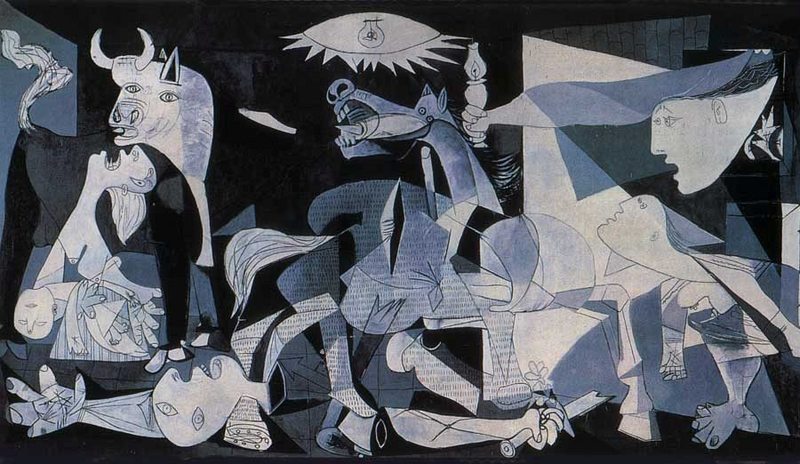
In February of 1981 I saw Pablo Picasso’s “Guernica” with my then-11-year-old daughter. When the Museum of Modern Art’s elevator doors opened the sight of the 25-foot wide masterpiece was so stunning the doors began to close before the spell was broken.

Picasso's “Guernica”

A few months later, upon the 100-year anniversary of Picasso’s birth, history’s most celebrated piece of anti-war art was packed up and sent to the Reina Sofia Museum in Madrid, Spain. However, a large copy of “Guernica” hangs on the second floor of the United Nations building -- a tapestry donated to the U.N. by Nelson Rockefeller’s estate in 1985.

On the occasion of then-Secretary of State Colin L. Powell’s February 5, 2003, presentation, underlining his president’s impatience with U.N. members seeking to avoid or delay war in Iraq, the tapestry was completely covered by a blue drape. Powell, or somebody on his staff, apparently realized that even a replica of that particular piece had to be avoided as a backdrop of any photographs of him on that fateful day.

Ten years after the invasion of Iraq, I wonder how much of what Powell said that day he knew then had been ginned up by propagandists in the Bush administration. And, I wonder how much of what he said he believed was true.

*

In some ways little has changed at the heart of arguments concerning war and occupation since France’s army -- as driven by the empire-building vision of Napoleon Bonaparte -- was an occupying force in Spain.

Overwhelmed by the brutality of France’s campaign of terror to crush the Spanish will to resist, Francisco Goya (1746-1828) -- a well-connected artist who had much to lose -- took it upon himself to remove the romantic veil of glory which had always been draped over paintings of war in European art. Documenting what he saw of war, firsthand, the images Goya hurled at viewers of his paintings and prints radically departed from tradition.

Instead of heroic glorification Goya offered horrific gore. The art world hasn’t been the same since.

Following in Goya’s footsteps artists such as Honore Daumier (1808-1879), Georges Rouault (1871-1959), Frans Masereel (1889-1971), Otto Dix (1892-1969), among many others, created still more haunting images illustrating the grittier aspects of modern war. In the midst of the Spanish Civil War, with the storm clouds of World War II gathering, Spaniard Pablo Picasso (1881-1973) created “Guernica.”

On April 27, 1937, to field test state-of the-art equipment, Adolf Hitler loaned a portion of Germany’s air force, the Condor Legion, to a fellow fascist dictator -- Spain’s Francisco Franco. The mission: to bomb a small town a few miles inland from the Gulf of Biscay; a Basque village that had no strategic value whatsoever.

The result: utter terror.

Bombs rained on Guernica for over three hours; cold-blooded machine gunners mowed down the poor souls who fled into the surrounding fields.

Four days later with grim photographs of mutilated corpses on the front pages of French newspapers a million outraged Parisians took to their streets to protest the bombing of Guernica.

That same day Picasso, who was in Paris, dropped everything else and began sketching studies for what became “Guernica.” As Spain’s government-in-exile had already commissioned him to create a mural for its pavilion in the upcoming Paris World’s Fair, the inspired artist already had the perfect place to exhibit his statement -- a shades-of-gray, cartoonish composition made up of a terrified huddle of people and animals.

When the fair closed “Guernica” needed a home. Not only was the Spain of Generalissimo Franco out of the question, Picasso decided it wouldn’t be safe anywhere in Europe. He was probably right. Thus, the huge canvas was shipped to the USA and eventually wound up calling MOMA its home until 1981.

*

Colin Powell, a former four-star general, who, unlike some of Bush’s hawkish neoconservative experts, knew war firsthand, from the inside out. It seems the Secretary knew something about art history, as well. Six weeks before the invasion of Iraq, he apparently retained a firm grasp on the potential of “Guernica” to cast a bitterly ironic light upon his history-making utterances.

That, while he may have lost his grip on what had been his honor. Instead of resigning because he disagreed with the Bush policy, Powell said, “We also have satellite photos that indicate that banned materials have recently been moved from a number of Iraqi weapons of mass destruction facilities...”

Now, on the 10-year anniversary of the invasion of Iraq, Powell lives with the memory of the strategic blue drape that was thrown over “Guernica,” and the symbolic blue drape that he helped to throw over the truth.

-- 30 --

Thursday, March 7, 2013

The Withering Fear of Being 'Primaried'

Because so many elected Republicans have become witheringly fearful of getting “primaried,” the GOP has developed a problem that is steadily getting worse. In order to stave off such challenges from extreme rightwing candidates, incumbents have been preemptively moving to the right on all sorts of issues.

That crab-walking migration toward the past is making Republicans less appealing in general elections, because John Q. Public usually isn‘t so happy voting for candidates who seem to have lost touch with reality. And, Jane Q. Public isn't getting any happier at all about voting for candidates who appear to be marching to the cadence of a "war on women" strategy.

"If it's a legitimate rape, the female body has ways to try to shut that whole thing down,” said losing senatorial candidate Todd Akin. "I'm not a witch," said losing senatorial candidate Christine O'Donnell. That's not the end of the career-crushing quotes, but there's no need to go on.

The point is, if Republicans could get better turnouts, if the turnout in primaries could be larger and more representative of the whole party, there would be less need for Republican incumbents to fear crazy rightwing challengers. And, there would be less need for them to distance themselves from the center of the political spectrum for the entire nation.

Still, for whatever reasons in the last few years, many Republicans have acted like that option hasn't been possible. By that they're saying that most conservatives can't be motivated to participate, so the party has to go on being at the mercy of activists on the far-right.

At this writing, it seems young voters are likely to keep moving that hypothetical center of the spectrum further to the left than it is now. If that's true, the problem for Republicans is going to snowball.

Maybe Republicans should consider doing away with primaries.

When using primaries, instead of conventions, suddenly became much more popular -- 40-some years ago -- the thinking was that primaries would make the nominating process more inclusive. It was seen then as a boon to undiluted democracy, because it would do away with the decisions made behind closed doors in smoke-filled rooms.

As far as either party is concerned, how has moving the decision-making to taking place in ad agencies and Super Pacs been a boon to democracy? Truth be told, primaries frequently empower the candidates with deep pockets, because they can throw a lot of money at two elections.

Well, maybe the experiment hasn't really worked so well for either party, but right now -- via primaries -- it's the Republicans who seem to be choking on their own bile.

-- 30 --

Wednesday, March 6, 2013

The Sequester Monster’s Horsefeathers

The Sequester Monster has been let out of its cage ... IT is on the loose!

What mischief might it do first? How afraid of tomorrow's Sequester Monster front page story should we be? What does it eat?

So far this crisis hasn’t had the suspense of the Debt Ceiling showdown in 2011. Maybe it's going to be a bigger deal than 2012’s Fiscal Cliff brouhaha was.

Maybe.

While the cable news channels work the monster’s story for all it’s worth, we can only guess at what history will think of 2013’s new version of the same old inside-the-beltway tug-of-war game about spending priorities. What's new here? Elephants like to spend on the military and adventures overseas; they like to subsidize big business. Donkeys like to spend on social programs and infrastructure; they'd rather subsidize a safety net.

For what it's worth, so far, Wall Street doesn’t seem all that scared of the monster's potential.

Will this new gimmick eventually be called a tipping point, a time that changed the direction of American politics? Or, will it soon be seen as another fizzler of a stunt, one that barely mattered outside the beltway?

Ten years from now, will it be called something other than the Sequester?

That seems likely.

The Sequester was spawned by the Budget Control Act of 2011, which made a law out of the compromise that ended the Debt Ceiling crisis of that year’s summer. That was the crisis that threatened to have Uncle Sam telling his creditors to be patient waiting for his overdue payments. Anyway, no matter who might be said to have originally thought up the concept of the Sequester, it was Congress that breathed life into the monster -- a rough beast slouching its way toward Easter.

Yes, both major political parties signed onto the trip we’re on with this business. It was the utter failure of Congress’ own handpicked Super Committee that set the doomsday machine's clock to ticking.

Which means to blame the White House for putting Congress on the horns of this dilemma doesn't jibe with the truth. Republicans pretending the Obama administration created the monster and set it loose know better.

Obviously, the Republican leadership in Congress has decided that it wants to keep moving from one crisis to the next for a while, perhaps through the mid-term elections. No doubt, the authors of this risky strategy have had this plan focus-grouped. Which means they think they know how the voters, or at least Republican-leaning voters, will react once the effects of slashed budgets become increasingly apparent.

One reason it’s a risky strategy is that it’s mostly just a strategy. There’s no coherent philosophy behind it; there’s no wizard behind the curtain. After all, the tax loopholes that Republican spokespersons are saying they will not allow to be closed -- not under any circumstances! -- are some of the same loopholes they wanted to consider closing last year, when the crisis du jour was that Fiscal Cliff thingy.

By the way, there’s yet another debt ceiling brinkmanship joust looming on the springtime horizon ... and so it goes.

What, pray tell, does IT eat?

Maybe 10 years from now these recent propaganda battles over money and the proper role of government will be called The Horsefeathers Avalanche.

Meanwhile, standby for the inevitable accusations from Tea Party’s propagandists, claiming the socialists in the Obama administration are gaming the effects of the sequester-driven cuts. They will say the suffering is being targeted to rough up and outrage middle class voters. That, heavens-to-Betsy, while the federal government continues to redistribute your tax dollars to the purses of welfare queens driving solid gold Cadillacs.

What the GOP brain trust may have taken away from those focus groups was that if Republicans can’t come coalesce as party in 2013 to offer up some warmed-over conservative-minded solutions for real problems -- like, right now who wants to talk about problems with guns? -- then the best thing to do would be to create some new problems, irritations Republicans can seem to have a hand in soothing.

In theory, such a strategy might hamstring Democratic efforts to get public support for their warmed-over liberal solutions to problems such as health care costs, a crumbling infrastructure and climate change. For sure, the ax-wielding Sequester Monster has already made one somewhat liberal opinion writer become a shameless mixer of metaphors.

As far as any fresh ideas go, with sequels to The Horsefeathers Avalanche already on the drawing board, who’s got the time to consider anything new?

And, so it goes...

-- 30 --

Tuesday, January 8, 2013

Weapons of Mass Murder

Since plenty of people drive their cars while inebriated, should we do away with Virginia's laws against drunk driving? Since rapes occur every day, in spite of laws prohibiting rape, why not also take those laws off the books? Since some bad citizens toss cigarette butts, gum wrappers and beer bottles wherever they please, without regard for anti-littering laws, what good are the laws?

OK. I'll stop stretching the opening point, which is: Only children or outrageously selfish adults, who live to do as they please, would ask such questions.

That's because most thoughtful grownups have enough experience with life to recognize that the inability of laws to prevent all instances of bad behavior is hardly cause to eliminate the laws.

Most of us know the laws against the doings in the first paragraph routinely prevent millions of bad things from happening. They deter some people who simply don’t want to get caught and punished, while they set standards for others who recognize them as clear expressions of the community's sentiments.

Therefore, we say: Please don’t drive drunk, you’re more likely to hurt somebody. Never rape, it is immoral. And, littering is so disgusting and selfish that all modern societies prohibit it. Whether the laws against such antisocial behavior are always obeyed doesn’t stop them from branding it for all to see as wrong.

Societies need a collective sense of right and wrong.

Then there are the ideologues and shills for arms merchants who defend the private ownership of military weapons -- such as assault rifles -- by saying Timothy McVeigh killed a lot of people in Oklahoma City without using bullets. Or, Jim Jones murdered his flock with poison Kool-Aid. Or, some other headline-making mass murderer used something other than an assault rifle.

So what!

No one thinks outlawing assault rifles will put an end to all bullet-caused murders. What it would do is make it more difficult for the next madman to kill a bunch of people in a few seconds, especially if he uses a large magazine. Renewing the ban on assault rifles would make them harder to get, so it would improve society‘s odds.

If it stops 10 madmen -- and yes it’s always males -- from getting a hold of an assault rifle, it might not prevent every one of them from going on a murder spree. But it would stop some percentage of them, because it’s obvious the mass-murderers’ top tool of choice is not a bolt-action rifle or a revolver.

Nor is it a bomb made out of fertilizer.

We, who choose not to own and fire assault rifles, can only guess at how much a potential murder spree guy might be emboldened by holding one tight as he imagines himself charging into an elementary school.

The more assault rifles there are in private hands, the more likely it is that you, your kid, or your dog is going to get shot by one of them. God only knows how many rapid-fire killing machines of this ilk are stashed on private property, waiting for the right crazy thief to steal them. And, after he does, it won't be just your dog or mine that will fall victim.

No, every damn dog in sight will get mowed down; slaughtered by way of a soldier's weapon designed to give a bad marksman the ability to kill every creature in sight with a flash of whim.

Isn't that exactly what a weapon of mass destruction is designed to do?

Hey, I don’t want tanks full of nerve gas or nukes in briefcases to fall into private hands, either. Even if the laws of the land can’t guarantee no bad actor ever will ever get his hands on them, oh yeah! I still want the laws against civilians possessing them enforced as well as can be done.

The proper enforcement of those laws helps to improve our odds. So would a ban on assault rifles. Bill Clinton might say, "It's arithmetic."

Anyway, don't tell me all the rapid-fire-armed murderers who have gone postal in the last few years would simply have switched over to bombs, or poison, if they couldn't have gotten a hold of their favorite tools.

Here's why I say that: Every bit as much as the grisly results, those shooters who fired indiscriminately into crowds wanted the thrill of shooting. They weren't bombers or poisoners. They were shooters. That's THE angle in this noisy brouhaha the ideologues and shills don't want to talk about -- the thrill.

-- 30 --